




GET FIT TECH
Sign up for the FREE digital edition of Fit Tech magazine and also get the Fit Tech ezine and breaking news email alerts.
Not right now, thanksclose this window I've already subscribed!
EGYM | Fit Tech promotion
features

New opening: An active education

A free school in Luton is the first in the UK to be set up by a leisure trust. But what do leisure trusts know about education and what value can they really add? In the case of Active Luton, quite a lot, as it turns out. Rhianon Howells talks to CEO Helen Barnett

Published in Health Club Management 2014 issue 2

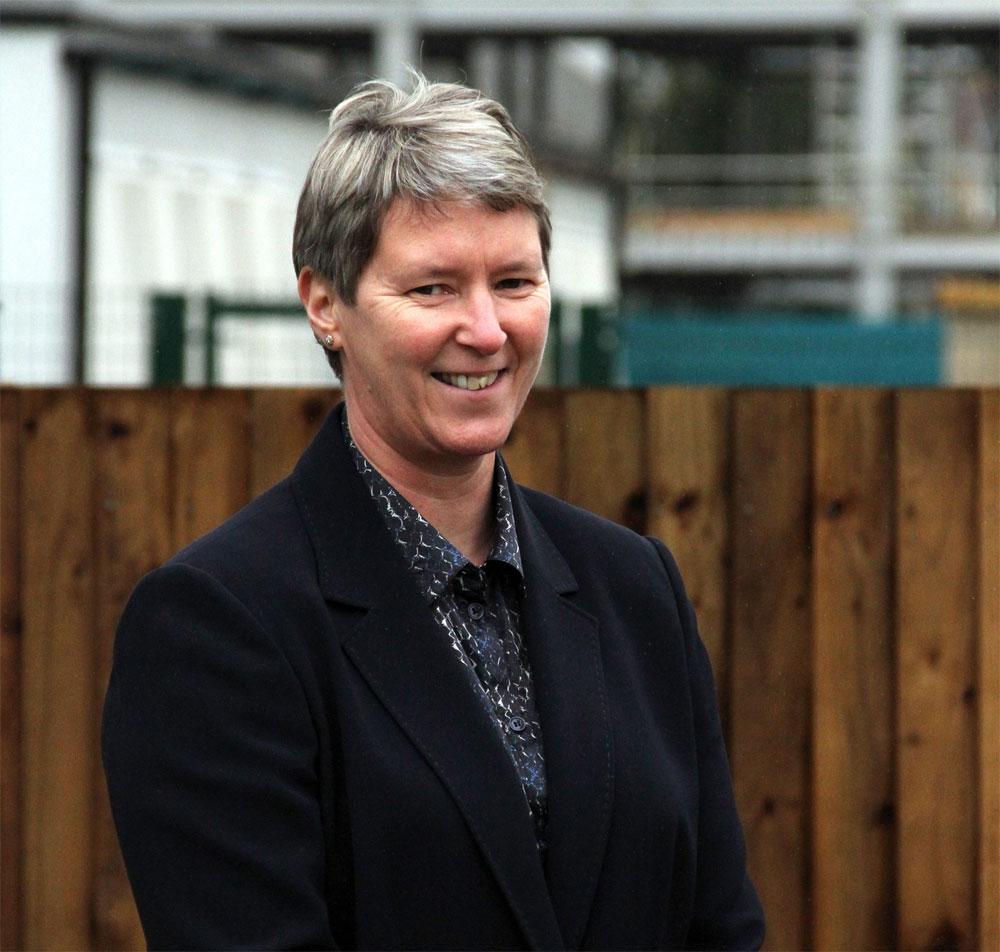
When the reception class pupils at River Bank Primary School in Luton, Bedfordshire, UK, walked through their school gates for the first time last September, Helen Barnett – CEO of leisure trust Active Luton – had never felt more proud or emotional.

Barnett, however, was not among the parents dropping off their sons and daughters for their first day of school. Her baby was not one of the four- and five-year-olds taking their first steps towards independence, but rather the school itself: the country’s first free school to be set up by a leisure trust and the first to base its ethos on physical activity, health and wellbeing.

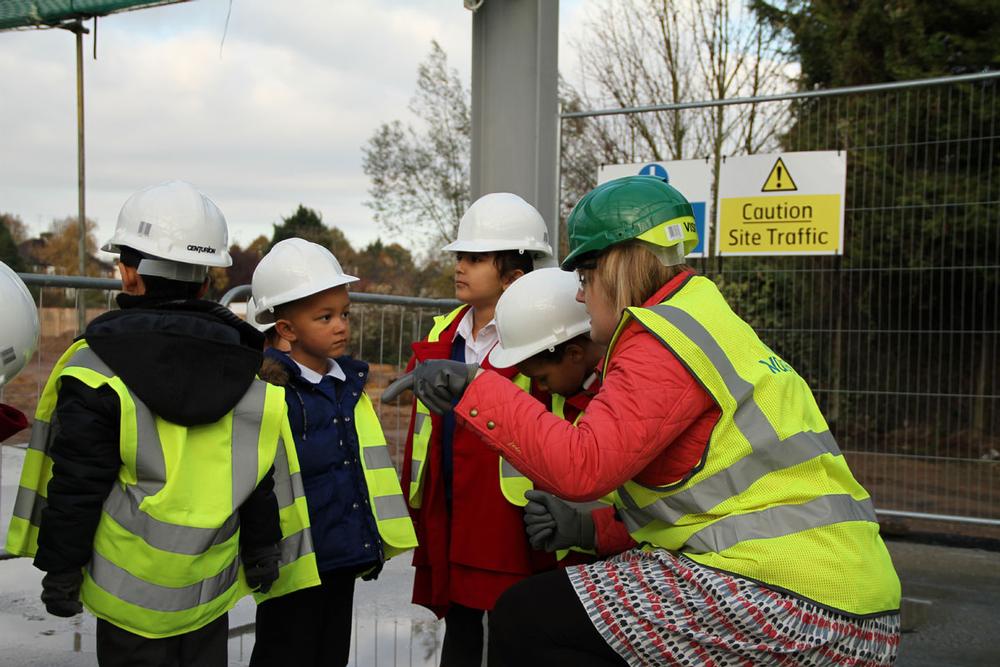
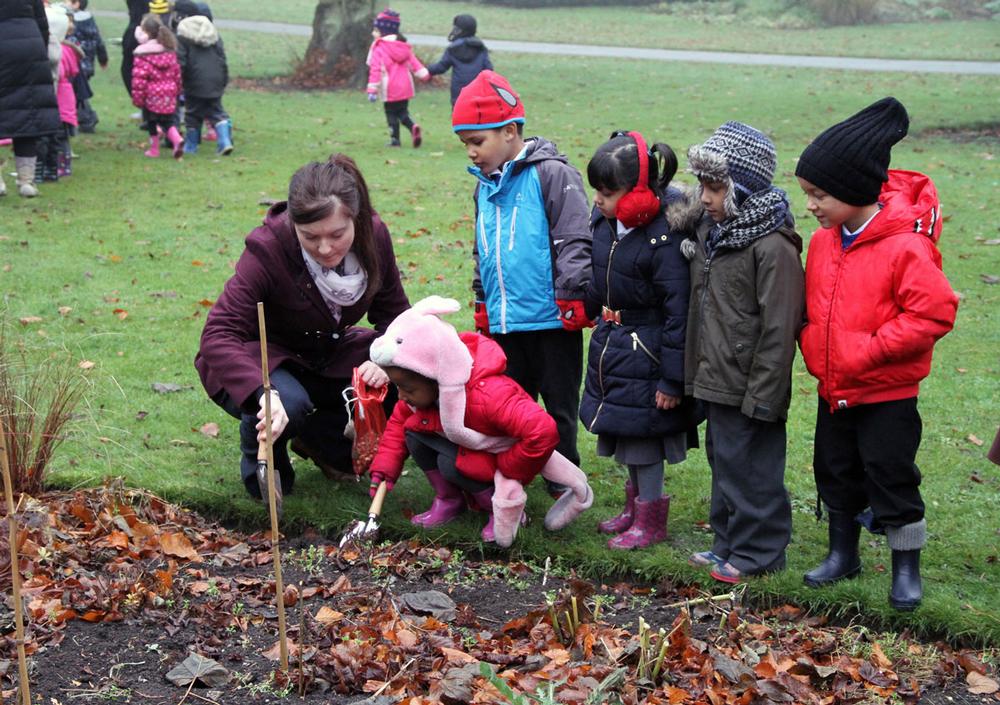
River Bank Primary School, located in one of the town’s most deprived areas, is still very much a fledgling project. Opened in 2013 with just two reception classes, it will add another year group each year until it has reached full capacity. This year, the children are being taught in mobile classrooms on the edge of a building site; from an adjacent playground they can watch their brand new, two-storey school going up. Work is due for completion by 22 August 2014, with the second school year beginning a couple of weeks later.

It’s a tight deadline, but if the last two years prove anything, it’s that Barnett is not afraid of a challenge – after all, there is no precedent for what they’re doing. But although convincing the authorities, the community and parents that a leisure trust can indeed run a school has been no mean feat, she is quick to stress that both she and Active Luton have a track record that make them ideally suited to be pioneers in this field.

STRONG CREDENTIALS
A PE teacher for 15 years, Barnett joined Luton Council’s school improvement team as PE advisor in 1999. Three years later, thanks to the vision of “an incredibly forward-thinking boss”, her remit was widened to include the management of both sports development and facilities, so that for the first time everything to do with physical activity – in schools, community outreach and council-run leisure centres – was brought under a single umbrella.

When Active Luton was set up in 2005 to run the council’s leisure facilities and sports development initiatives, Barnett was appointed CEO and simply carried on the good work. As a result, uniquely among leisure trusts, Active Luton has not only a large community outreach team but also a well-established education team including qualified and experienced teachers.

Since then, the trust has worked with numerous primary and secondary schools in Luton to promote physical activity: from helping them to improve the quality of their PE provision and running extra-curricular sports clubs to training teachers in how to introduce activity into their English and maths lessons (Literacy in Action and Numeracy in Action) and reviving playground games. “You’d struggle to find a school in Luton we haven’t worked with,” says Barnett.

Far from seeing its schools outreach as separate from its sports and leisure operations, Active Luton encourages all of its centres to forge links with the schools closest to them – from pre-schools through to sixth-form colleges – via swimming programmes and other initiatives such as hosting inter-school competitions.

“We want there to be those links, because these children are going to grow up to become future customers,” points out Barnett. “It’s also a great way to get to their parents through them.”

In 2006, the trust signed up for a national pilot project run by the Youth Sports Trust, aimed at seeing if increasing physical activity in primary schools would have the same positive impact on standards that had already been seen at secondary Sports Colleges. Over a four-year period, Barnett and her team worked closely with teachers at Foxdell Primary School in Luton to embed physical activity into all aspects of the curriculum and school life, with impressive results.

“Oh, gosh, the impact it had was unbelievable,” she says. “We did lots of work on Literacy in Action and Numeracy in Action, which helped raise their SAT scores – over four years, the proportion of children achieving level 4 in English went from 77 to 91 per cent; maths went from 74 to 90 per cent; and science from 80 to 93 per cent. It improved attendance, increased confidence and self-esteem… I’m not saying it was all PE, but I can show you quotes from the head teacher that testify to our contribution.”

And she can. “The attendance and behaviour statistics are testimony to the fact that the children enjoyed coming to school, felt part of a team, believed in themselves, were confident, could speak up for themselves and were ready to have a go at anything,” said head Lynne McMulkin in the free school application. “The pilot transformed pupils from passive to active learners in every sense.”

Leap of faith
Why, though, did Active Luton decide to set up a school dedicated to this philosophy, rather than simply continuing to partner with existing schools in Luton? The way Barnett tells it, it was almost fate: the town was desperately short of primary school places and, in the area where demand was greatest, Active Luton had a swimming pool that was about to close down. “Everything came together at the same time,” she says. “The new government came in and introduced the concept of free schools; there was a shortage of school places; we had a concept we believed passionately in; and we had a potential site.”

Under government guidelines, all free schools must be operated by an academy trust, so Active Luton’s first move was to set up the Active Education Academy Trust. After its application, the trust received the green light in July 2012, leaving Barnett and her team just over a year to get ready for the first intake of pupils.

Often described as state-maintained independent schools, free schools receive their funding direct from the Department of Education rather than the local authority. It’s no small investment: the budget for the new school building is £7.5m, while set-up costs are in the region of £100,000. Once the school is up and running, however, it will receive the same per capita funding as any local authority-run school, says Barnett.

Ever since the government introduced them, free schools have been controversial, generating accusations that they take pupils – and therefore funding – from other schools. But in Luton’s chronically over-subscribed primary schools, this could not be further from the truth, says Barnett, who is keen to stress that the venture has the full backing of the council. “The first thing we did was go and talk to the local authority, because we have a very positive relationship with them,” she says. “They were 100 per cent supportive, which is not typical for free schools. But they recognised we had the credibility and were really appreciative that we wanted to work alongside them.”

Barnett also points out that, unlike other free schools which have attracted criticism for eccentric curricula, River Bank Primary is following the National Curriculum; it’s not so much what is taught but how it’s taught that will vary.

The real difficulty, she says, was not convincing the council but convincing parents. “It was a massive challenge to persuade any parent to send their child to us, because at the time the school had no track record, no teachers and no building, and there were other quality schools in the area. So it was a huge leap of faith for parents, much as they believed what we saying.”

Getting the community on board was also challenging. “We knew some of the groups were looking at us and thinking: ‘What do you know about being part of our community? You manage sports centres.’ It was a case of winning hearts and minds. We’ve had people walking up and down the high street dressed in all sorts of ridiculous outfits, and been to no end of community events, just to get them to trust us.”

Education in action
River Bank’s ethos, says Barnett, is based on Olympic and Paralympic values so amply demonstrated in the 2012 Games: teamwork, trust and respect, but also a competitive spirit: “It’s about doing your best and competing against yourself to do even better.”

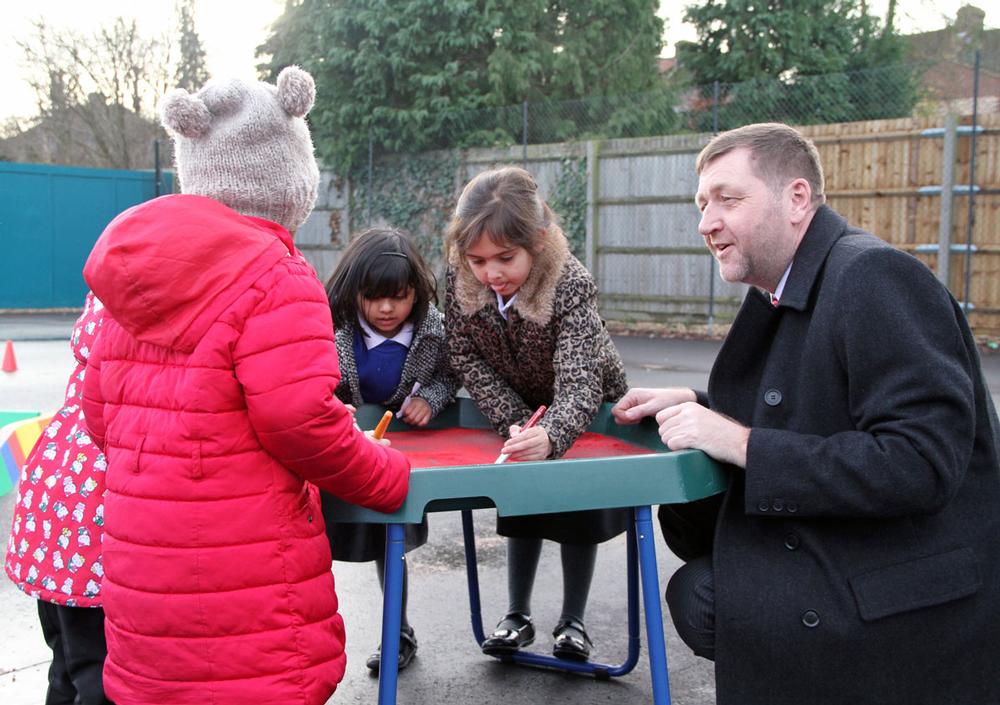
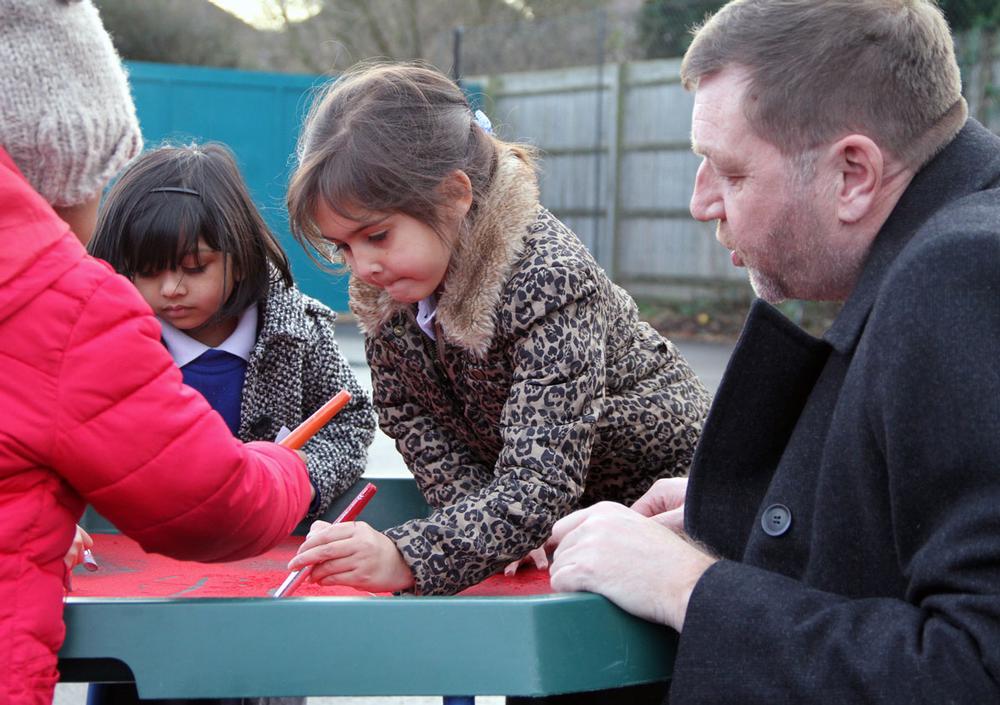
As at Foxdell, there’s a strong emphasis not only on high-quality PE provision – the new building will include a dedicated two-court sports hall – but also on integrating activity into non-PE lessons. So in maths, for example, learning to count and add up might involve throwing and catching, while in English the children might be asked to create an interpretive dance to accompany their poems about the sea. With the majority of pupils at River Bank coming from Asian or Polish families, this practical approach to learning is particularly helpful for children for whom English is a second language, says Barnett.

The importance of diet in a healthy lifestyle is also on the agenda, with lessons on healthy eating and a designated cookery area in the new building. And although it’s less relevant for the reception classes, there will be a strong emphasis on activity-focused breakfast, lunchtime and after-school clubs as pupils move through the school.

While the school will employ PE specialists, other teachers aren’t expected to be PE-qualified, though they are expected to be “outstanding practitioners” with a passionate belief in active education. The other factor that’s crucial to the success of the concept is the involvement of parents. “Research shows the greatest influence on whether a child is active or not is whether they have an active mother,” says Barnett.

When it comes to tackling problems like obesity – levels of which are higher around River Bank Primary than in other areas of Luton, while life expectancy is shorter – parental engagement is even more crucial. “It has to be about supporting families, because actually the child has very little say in it,” says Barnett. “We can encourage a child to be more active, but if they then go home and have a fry-up every day, there’s nothing we can do about it.”

To this end, a large part of the school’s remit is to serve not only its children, but also their families and the wider community. The school is already offering weekly activity sessions for parents and even grandparents in a local church hall, but once the new building is complete this will be ratcheted up. “We want to make the school an absolute hub within the local community,” says Barnett. “We’ve built in a family room where we’ll offer all sorts of activities, for families and parents on their own.”

While family activities will focus on fostering positive interaction between parents and children – such as Dads and Lads sessions – options for parents will include exercise classes, talks on healthy eating, and literacy and numeracy programmes. Eventually, says Barnett, she’d like to see the school open from 7.00am to 10.00pm, seven days a week.

High aspirations
Barnett has every confidence in the school’s head, John Wrigglesworth, a seasoned teacher with 12 years’ experience as a primary head and 10 as a local authority schools advisor. With the second term now underway, she’s pleased with how things are going: “The children have responded really well and the parents… the number of parents who wanted to be parent-governors is just unheard of.”

She is aware, however, that the road ahead will not be an easy one. Aside from the challenge of getting the new school open on time, every year for the next seven years will require a full-on recruitment drive to attract not only the best teachers but also the best teaching assistants, family workers and other staff. Most important of all will be the continuing campaign to get parents on board. “We want to be their absolute first choice of school,” says Barnett, adding that the ultimate goal is an outstanding OFSTED report.

To measure River Bank’s success, Active Luton will be tracking attendance and academic results (as far as possible in the absence of standardised tests), but Barnett will also be looking for other indicators of the school’s success. “I hope our children will be inspired to have high aspirations,” she says. “Their personal achievement is crucial to us… we want them to be confident, happy, the best that they can be.”

Much as she believes in the model they have created, Barnett is not convinced that other leisure trusts have the wherewithal to follow in their footsteps: “I can see another leisure trust doing this in partnership with an education organisation, but I don’t know that there’s another leisure trust that employs a team of teachers.”

When pushed, however, Barnett doesn’t rule out the possibility of Active Luton opening more schools of its own in the future. “Oh, gosh, everyone else who works here would kill me!” she says. “I’d like to think that we’d do more; our education work is so important to the whole meaning of Active Luton.”
Sign up here to get Fit Tech's weekly ezine and every issue of Fit Tech magazine free on digital.
Gallery
More features
Editor's letter

Into the fitaverse

Fitness is already among the top three markets in the metaverse, with new technology and partnerships driving real growth and consumer engagement that looks likely to spill over into health clubs, gyms and studios
Fit Tech people

Ali Jawad

Paralympic powerlifter and founder, Accessercise
Users can easily identify which facilities in the UK are accessible to the disabled community
Fit Tech people

Hannes Sjöblad

MD, DSruptive
We want to give our users an implantable tool that allows them to collect their health data at any time and in any setting
Fit Tech people

Jamie Buck

Co-founder, Active in Time
We created a solution called AiT Voice, which turns digital data into a spoken audio timetable that connects to phone systems
Profile

Fahad Alhagbani: reinventing fitness

Let’s live in the future to improve today
Opinion

Building on the blockchain

For small sports teams looking to compete with giants, blockchain can be a secret weapon explains Lars Rensing, CEO of Protokol
Innovation

Bold move

Our results showed a greater than 60 per cent reduction in falls for individuals who actively participated in Bold’s programme
App analysis

Check your form

Sency’s motion analysis technology is allowing users to check their technique as they exercise. Co-founder and CEO Gal Rotman explains how
Profile

New reality

Sam Cole, CEO of FitXR, talks to Fit Tech about taking digital workouts to the next level, with an immersive, virtual reality fitness club
Profile

Sohail Rashid

35 million people a week participate in strength training. We want Brawn to help this audience achieve their goals
Ageing

Reverse Ageing

Many apps help people track their health, but Humanity founders Peter Ward and Michael Geer have put the focus on ageing, to help users to see the direct repercussions of their habits. They talk to Steph Eaves
App analysis

Going hybrid

Workout Anytime created its app in partnership with Virtuagym. Workout Anytime’s Greg Maurer and Virtuagym’s Hugo Braam explain the process behind its creation
Research

Physical activity monitors boost activity levels

Researchers at the University of Copenhagen have conducted a meta analysis of all relevant research and found that the body of evidence shows an impact
Editor's letter

Two-way coaching

Content providers have been hugely active in the fit tech market since the start of the pandemic. We expect the industry to move on from delivering these services on a ‘broadcast-only’ basis as two-way coaching becomes the new USP
Fit Tech People

Laurent Petit

Co-founder, Active Giving
The future of sports and fitness are dependent on the climate. Our goal is to positively influence the future of our planet by instilling a global vision of wellbeing and a sense of collective action
Fit Tech People

Adam Zeitsiff

CEO, Intelivideo
We don’t just create the technology and bail – we support our clients’ ongoing hybridisation efforts
Fit Tech People

Anantharaman Pattabiraman

CEO and co-founder, Auro
When you’re undertaking fitness activities, unless you’re on a stationary bike, in most cases it’s not safe or necessary to be tied to a screen, especially a small screen
Fit Tech People

Mike Hansen

Managing partner, Endorphinz
We noticed a big gap in the market – customers needed better insights but also recommendations on what to do, whether that be customer acquisition, content creation, marketing and more
More features
Panatta's mission is to create machines that are aesthetically pleasing, functional and competitive in price ...
Fitbench creates modular training solutions designed to support efficient, high-quality workouts in a wide range ...
22-23 Sep 2026
Four Seasons Hotel Bangkok at Chao Phraya River, Bangkok , Thailand
Panatta's mission is to create machines that are aesthetically pleasing, functional and competitive in price ...
Fitbench creates modular training solutions designed to support efficient, high-quality workouts in a wide range ...
Get Fit Tech
Sign up for the free Fit Tech ezine and breaking news alerts
Sign up
22-23 Sep 2026
Four Seasons Hotel Bangkok at Chao Phraya River, Bangkok , Thailand

latest fit tech news

PureGym is encouraging people to step away from their screens and go for a walk, in a new initiative timed ...
news • 29 May 2026
Active people app, Strava, has overhauled its strength training experience, allowing gym-goers to automatically log and share their lifts from ...
news • 27 May 2026

Fitness First UK is embracing digital wellness technology by installing Kip’s tap-to-activate phone controls across its UK estate. Kip tags ...
news • 22 May 2026
The world’s first awareness ring has been launched. Designed to promote presence, focus and calm via gentle haptic vibrations, the ...
news • 13 May 2026
Center Parcs’ Aqua Sana Forest Spa, Woburn Forest, UK, has transformed an unused space into a touchless wellness area called ...
news • 12 May 2026
Gharieni Group has launched a new company, Cobotics Innovations, to create automated wellness experiences. The first solution is a robotic ...
product innovation • 07 May 2026

US-based robotics wellness company Aescape Inc has entered insolvency proceedings following the sale of substantially all of its ...

news • 06 May 2026
Fitness platform, Zing Coach, has teamed up with Les Mills, in a partnership that gives its users access to group ...
news • 23 Apr 2026

TMActive is launching a new Active Wellbeing Studio next month in Tonbridge, UK, specifically aimed at people who face higher ...
news • 13 Apr 2026

Indian billionaire, Deepinder Goyal, is working on a device called Temple that aims to track blood flow to the brain ...
news • 10 Apr 2026
More fit tech news
features

New opening: An active education

A free school in Luton is the first in the UK to be set up by a leisure trust. But what do leisure trusts know about education and what value can they really add? In the case of Active Luton, quite a lot, as it turns out. Rhianon Howells talks to CEO Helen Barnett

Published in Health Club Management 2014 issue 2

When the reception class pupils at River Bank Primary School in Luton, Bedfordshire, UK, walked through their school gates for the first time last September, Helen Barnett – CEO of leisure trust Active Luton – had never felt more proud or emotional.

Barnett, however, was not among the parents dropping off their sons and daughters for their first day of school. Her baby was not one of the four- and five-year-olds taking their first steps towards independence, but rather the school itself: the country’s first free school to be set up by a leisure trust and the first to base its ethos on physical activity, health and wellbeing.

River Bank Primary School, located in one of the town’s most deprived areas, is still very much a fledgling project. Opened in 2013 with just two reception classes, it will add another year group each year until it has reached full capacity. This year, the children are being taught in mobile classrooms on the edge of a building site; from an adjacent playground they can watch their brand new, two-storey school going up. Work is due for completion by 22 August 2014, with the second school year beginning a couple of weeks later.

It’s a tight deadline, but if the last two years prove anything, it’s that Barnett is not afraid of a challenge – after all, there is no precedent for what they’re doing. But although convincing the authorities, the community and parents that a leisure trust can indeed run a school has been no mean feat, she is quick to stress that both she and Active Luton have a track record that make them ideally suited to be pioneers in this field.

STRONG CREDENTIALS
A PE teacher for 15 years, Barnett joined Luton Council’s school improvement team as PE advisor in 1999. Three years later, thanks to the vision of “an incredibly forward-thinking boss”, her remit was widened to include the management of both sports development and facilities, so that for the first time everything to do with physical activity – in schools, community outreach and council-run leisure centres – was brought under a single umbrella.

When Active Luton was set up in 2005 to run the council’s leisure facilities and sports development initiatives, Barnett was appointed CEO and simply carried on the good work. As a result, uniquely among leisure trusts, Active Luton has not only a large community outreach team but also a well-established education team including qualified and experienced teachers.

Since then, the trust has worked with numerous primary and secondary schools in Luton to promote physical activity: from helping them to improve the quality of their PE provision and running extra-curricular sports clubs to training teachers in how to introduce activity into their English and maths lessons (Literacy in Action and Numeracy in Action) and reviving playground games. “You’d struggle to find a school in Luton we haven’t worked with,” says Barnett.

Far from seeing its schools outreach as separate from its sports and leisure operations, Active Luton encourages all of its centres to forge links with the schools closest to them – from pre-schools through to sixth-form colleges – via swimming programmes and other initiatives such as hosting inter-school competitions.

“We want there to be those links, because these children are going to grow up to become future customers,” points out Barnett. “It’s also a great way to get to their parents through them.”

In 2006, the trust signed up for a national pilot project run by the Youth Sports Trust, aimed at seeing if increasing physical activity in primary schools would have the same positive impact on standards that had already been seen at secondary Sports Colleges. Over a four-year period, Barnett and her team worked closely with teachers at Foxdell Primary School in Luton to embed physical activity into all aspects of the curriculum and school life, with impressive results.

“Oh, gosh, the impact it had was unbelievable,” she says. “We did lots of work on Literacy in Action and Numeracy in Action, which helped raise their SAT scores – over four years, the proportion of children achieving level 4 in English went from 77 to 91 per cent; maths went from 74 to 90 per cent; and science from 80 to 93 per cent. It improved attendance, increased confidence and self-esteem… I’m not saying it was all PE, but I can show you quotes from the head teacher that testify to our contribution.”

And she can. “The attendance and behaviour statistics are testimony to the fact that the children enjoyed coming to school, felt part of a team, believed in themselves, were confident, could speak up for themselves and were ready to have a go at anything,” said head Lynne McMulkin in the free school application. “The pilot transformed pupils from passive to active learners in every sense.”

Leap of faith
Why, though, did Active Luton decide to set up a school dedicated to this philosophy, rather than simply continuing to partner with existing schools in Luton? The way Barnett tells it, it was almost fate: the town was desperately short of primary school places and, in the area where demand was greatest, Active Luton had a swimming pool that was about to close down. “Everything came together at the same time,” she says. “The new government came in and introduced the concept of free schools; there was a shortage of school places; we had a concept we believed passionately in; and we had a potential site.”

Under government guidelines, all free schools must be operated by an academy trust, so Active Luton’s first move was to set up the Active Education Academy Trust. After its application, the trust received the green light in July 2012, leaving Barnett and her team just over a year to get ready for the first intake of pupils.

Often described as state-maintained independent schools, free schools receive their funding direct from the Department of Education rather than the local authority. It’s no small investment: the budget for the new school building is £7.5m, while set-up costs are in the region of £100,000. Once the school is up and running, however, it will receive the same per capita funding as any local authority-run school, says Barnett.

Ever since the government introduced them, free schools have been controversial, generating accusations that they take pupils – and therefore funding – from other schools. But in Luton’s chronically over-subscribed primary schools, this could not be further from the truth, says Barnett, who is keen to stress that the venture has the full backing of the council. “The first thing we did was go and talk to the local authority, because we have a very positive relationship with them,” she says. “They were 100 per cent supportive, which is not typical for free schools. But they recognised we had the credibility and were really appreciative that we wanted to work alongside them.”

Barnett also points out that, unlike other free schools which have attracted criticism for eccentric curricula, River Bank Primary is following the National Curriculum; it’s not so much what is taught but how it’s taught that will vary.

The real difficulty, she says, was not convincing the council but convincing parents. “It was a massive challenge to persuade any parent to send their child to us, because at the time the school had no track record, no teachers and no building, and there were other quality schools in the area. So it was a huge leap of faith for parents, much as they believed what we saying.”

Getting the community on board was also challenging. “We knew some of the groups were looking at us and thinking: ‘What do you know about being part of our community? You manage sports centres.’ It was a case of winning hearts and minds. We’ve had people walking up and down the high street dressed in all sorts of ridiculous outfits, and been to no end of community events, just to get them to trust us.”

Education in action
River Bank’s ethos, says Barnett, is based on Olympic and Paralympic values so amply demonstrated in the 2012 Games: teamwork, trust and respect, but also a competitive spirit: “It’s about doing your best and competing against yourself to do even better.”

As at Foxdell, there’s a strong emphasis not only on high-quality PE provision – the new building will include a dedicated two-court sports hall – but also on integrating activity into non-PE lessons. So in maths, for example, learning to count and add up might involve throwing and catching, while in English the children might be asked to create an interpretive dance to accompany their poems about the sea. With the majority of pupils at River Bank coming from Asian or Polish families, this practical approach to learning is particularly helpful for children for whom English is a second language, says Barnett.

The importance of diet in a healthy lifestyle is also on the agenda, with lessons on healthy eating and a designated cookery area in the new building. And although it’s less relevant for the reception classes, there will be a strong emphasis on activity-focused breakfast, lunchtime and after-school clubs as pupils move through the school.

While the school will employ PE specialists, other teachers aren’t expected to be PE-qualified, though they are expected to be “outstanding practitioners” with a passionate belief in active education. The other factor that’s crucial to the success of the concept is the involvement of parents. “Research shows the greatest influence on whether a child is active or not is whether they have an active mother,” says Barnett.

When it comes to tackling problems like obesity – levels of which are higher around River Bank Primary than in other areas of Luton, while life expectancy is shorter – parental engagement is even more crucial. “It has to be about supporting families, because actually the child has very little say in it,” says Barnett. “We can encourage a child to be more active, but if they then go home and have a fry-up every day, there’s nothing we can do about it.”

To this end, a large part of the school’s remit is to serve not only its children, but also their families and the wider community. The school is already offering weekly activity sessions for parents and even grandparents in a local church hall, but once the new building is complete this will be ratcheted up. “We want to make the school an absolute hub within the local community,” says Barnett. “We’ve built in a family room where we’ll offer all sorts of activities, for families and parents on their own.”

While family activities will focus on fostering positive interaction between parents and children – such as Dads and Lads sessions – options for parents will include exercise classes, talks on healthy eating, and literacy and numeracy programmes. Eventually, says Barnett, she’d like to see the school open from 7.00am to 10.00pm, seven days a week.

High aspirations
Barnett has every confidence in the school’s head, John Wrigglesworth, a seasoned teacher with 12 years’ experience as a primary head and 10 as a local authority schools advisor. With the second term now underway, she’s pleased with how things are going: “The children have responded really well and the parents… the number of parents who wanted to be parent-governors is just unheard of.”

She is aware, however, that the road ahead will not be an easy one. Aside from the challenge of getting the new school open on time, every year for the next seven years will require a full-on recruitment drive to attract not only the best teachers but also the best teaching assistants, family workers and other staff. Most important of all will be the continuing campaign to get parents on board. “We want to be their absolute first choice of school,” says Barnett, adding that the ultimate goal is an outstanding OFSTED report.

To measure River Bank’s success, Active Luton will be tracking attendance and academic results (as far as possible in the absence of standardised tests), but Barnett will also be looking for other indicators of the school’s success. “I hope our children will be inspired to have high aspirations,” she says. “Their personal achievement is crucial to us… we want them to be confident, happy, the best that they can be.”

Much as she believes in the model they have created, Barnett is not convinced that other leisure trusts have the wherewithal to follow in their footsteps: “I can see another leisure trust doing this in partnership with an education organisation, but I don’t know that there’s another leisure trust that employs a team of teachers.”

When pushed, however, Barnett doesn’t rule out the possibility of Active Luton opening more schools of its own in the future. “Oh, gosh, everyone else who works here would kill me!” she says. “I’d like to think that we’d do more; our education work is so important to the whole meaning of Active Luton.”
Sign up here to get Fit Tech's weekly ezine and every issue of Fit Tech magazine free on digital.
Gallery
More features
Editor's letter

Into the fitaverse

Fitness is already among the top three markets in the metaverse, with new technology and partnerships driving real growth and consumer engagement that looks likely to spill over into health clubs, gyms and studios
Fit Tech people

Ali Jawad

Paralympic powerlifter and founder, Accessercise
Users can easily identify which facilities in the UK are accessible to the disabled community
Fit Tech people

Hannes Sjöblad

MD, DSruptive
We want to give our users an implantable tool that allows them to collect their health data at any time and in any setting
Fit Tech people

Jamie Buck

Co-founder, Active in Time
We created a solution called AiT Voice, which turns digital data into a spoken audio timetable that connects to phone systems
Profile

Fahad Alhagbani: reinventing fitness

Let’s live in the future to improve today
Opinion

Building on the blockchain

For small sports teams looking to compete with giants, blockchain can be a secret weapon explains Lars Rensing, CEO of Protokol
Innovation

Bold move

Our results showed a greater than 60 per cent reduction in falls for individuals who actively participated in Bold’s programme
App analysis

Check your form

Sency’s motion analysis technology is allowing users to check their technique as they exercise. Co-founder and CEO Gal Rotman explains how
Profile

New reality

Sam Cole, CEO of FitXR, talks to Fit Tech about taking digital workouts to the next level, with an immersive, virtual reality fitness club
Profile

Sohail Rashid

35 million people a week participate in strength training. We want Brawn to help this audience achieve their goals
Ageing

Reverse Ageing

Many apps help people track their health, but Humanity founders Peter Ward and Michael Geer have put the focus on ageing, to help users to see the direct repercussions of their habits. They talk to Steph Eaves
App analysis

Going hybrid

Workout Anytime created its app in partnership with Virtuagym. Workout Anytime’s Greg Maurer and Virtuagym’s Hugo Braam explain the process behind its creation
Research

Physical activity monitors boost activity levels

Researchers at the University of Copenhagen have conducted a meta analysis of all relevant research and found that the body of evidence shows an impact
Editor's letter

Two-way coaching

Content providers have been hugely active in the fit tech market since the start of the pandemic. We expect the industry to move on from delivering these services on a ‘broadcast-only’ basis as two-way coaching becomes the new USP
Fit Tech People

Laurent Petit

Co-founder, Active Giving
The future of sports and fitness are dependent on the climate. Our goal is to positively influence the future of our planet by instilling a global vision of wellbeing and a sense of collective action
Fit Tech People

Adam Zeitsiff

CEO, Intelivideo
We don’t just create the technology and bail – we support our clients’ ongoing hybridisation efforts
Fit Tech People

Anantharaman Pattabiraman

CEO and co-founder, Auro
When you’re undertaking fitness activities, unless you’re on a stationary bike, in most cases it’s not safe or necessary to be tied to a screen, especially a small screen
Fit Tech People

Mike Hansen

Managing partner, Endorphinz
We noticed a big gap in the market – customers needed better insights but also recommendations on what to do, whether that be customer acquisition, content creation, marketing and more
More features