





EGYM | Fit Tech promotion
features

Town planning: Play full city

Over time, town planning has led to the creation of obesogenic environments, but Hamilton in New Zealand is taking a fresh approach to mobilising its population, by turning the city into a playground, as Kath Hudson reports

Published in Health Club Management 2021 issue 4

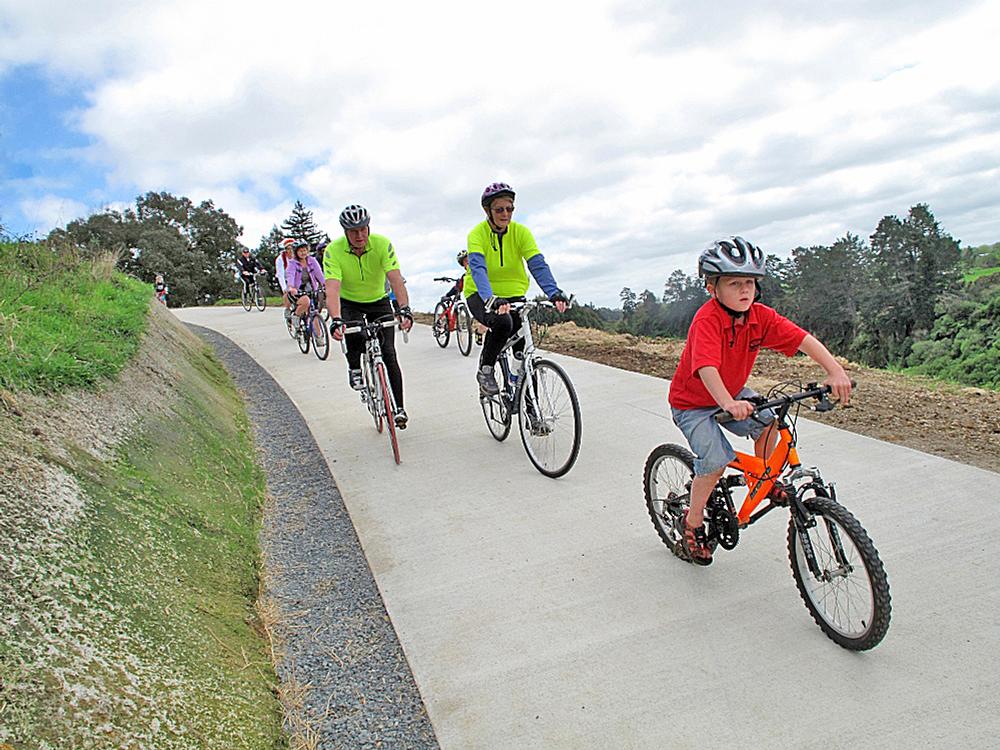
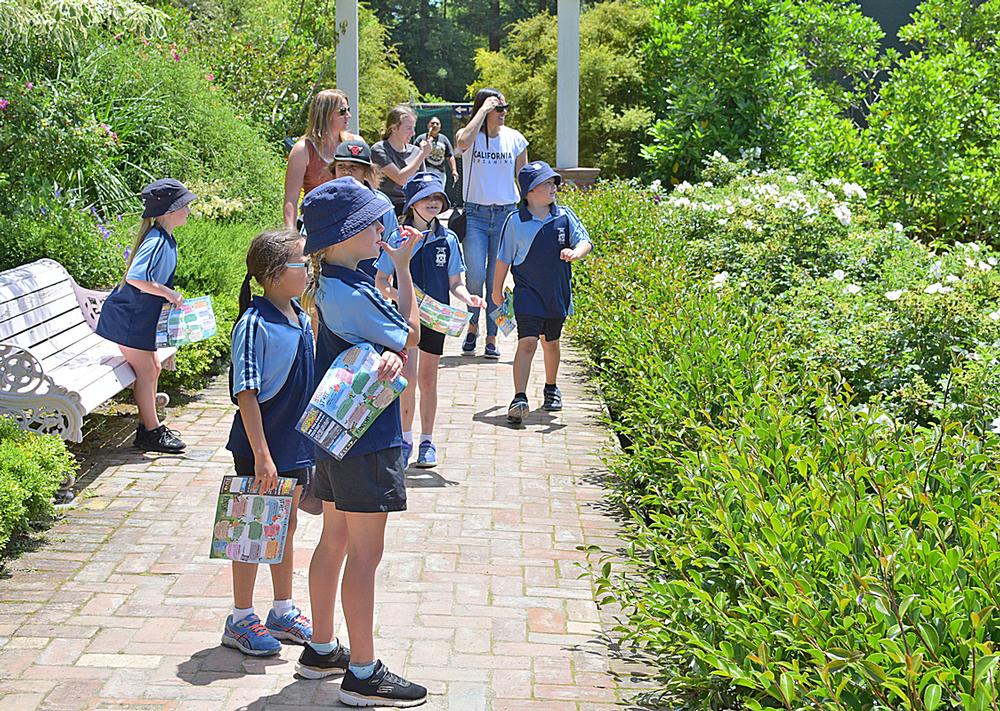
Underpasses becoming climbing walls, community access to school facilities, better integrated cycling and walking infrastructure and a mobile play trailer are all being considered by Hamilton City Council as ways of giving the city an injection of fun and encouraging people to travel by bike or on foot.

The city, in the Waikato region of the North Island – famous as the location of Middle Earth and The Shire, in The Lord of the Rings – is blessed with beautiful natural resources and an active population, but is still grappling with increases in obesity levels.

The New Zealand Health Survey 2019/20 found that one in three adults aged 15 and over were obese (30.9 per cent), with the prevalence of obesity differing with ethnicity: being 63.4 per cent in Pacific Islanders, 47.9 per cent in Maoris, 29.3 per cent in European/other and 15.9 per cent in Asians.

National activity guidelines in New Zealand are for adults to do 150 minutes of moderate exercise or 75 minutes of vigorous exercise throughout the week, but to double this for extra health benefits.

Having spent time living in New Zealand during the early noughties, it was great to see how much time people spent being active outdoors. This was thanks largely to the magnificent natural environment and the energetic Kiwi mindset, but government encouragement played a part too. The jingle from a public health advert still sticks in my mind, reminding me to “push play for 30 minutes a day.”

This belief in play being good for you has now been put at the heart of a sports and recreation strategy devised by Hamilton City Council, in consultation with the public, local sports clubs and other stakeholders, including Sport Waikato, which promotes play, active recreation and sport throughout the Waikato region.

The Play Strategy aims to boost physical activity levels by providing playful opportunities around the city for everyone and in so doing, transforming Hamilton into New Zealand’s most playable city.

Three different types of play are defined under the strategy: spontaneous play, organised sport and informal recreation.

Exercise should be fun
A review of Hamilton’s sports and recreation strategy, carried out in 2018, revealed two key findings: firstly that participation in organised sport – both in the city and nationally – was declining and although people understood the health benefits of physical activity, this wasn’t always translating into action; secondly, while participation in organised sport was declining, it was actually increasing in informal recreation.

The research also showed that 52 per cent of participants will only do physical activity if it’s fun – rising to 62 per cent among those aged five to 17 and that council assets, such as roads, walkways, public parks, fields and playgrounds, were the most common places for people to be physically active.

“This begged the question: what if we focus on play and fun for all ages?” says Hamilton City Council general manager community, Lance Vervoort. “What if fun was at the centre of our strategy and achieving the physical activity guidelines was a by product of fun? Would making the city more playful support people to play more?

“These questions provided a change in mindset, which enabled staff to focus on play for everyone and to reframe council assets such as walkways, street trees, open spaces, gullies, sports parks, aquatic facilities, footpaths and streets as play infrastructure where people can engage in physical movement and fun.”

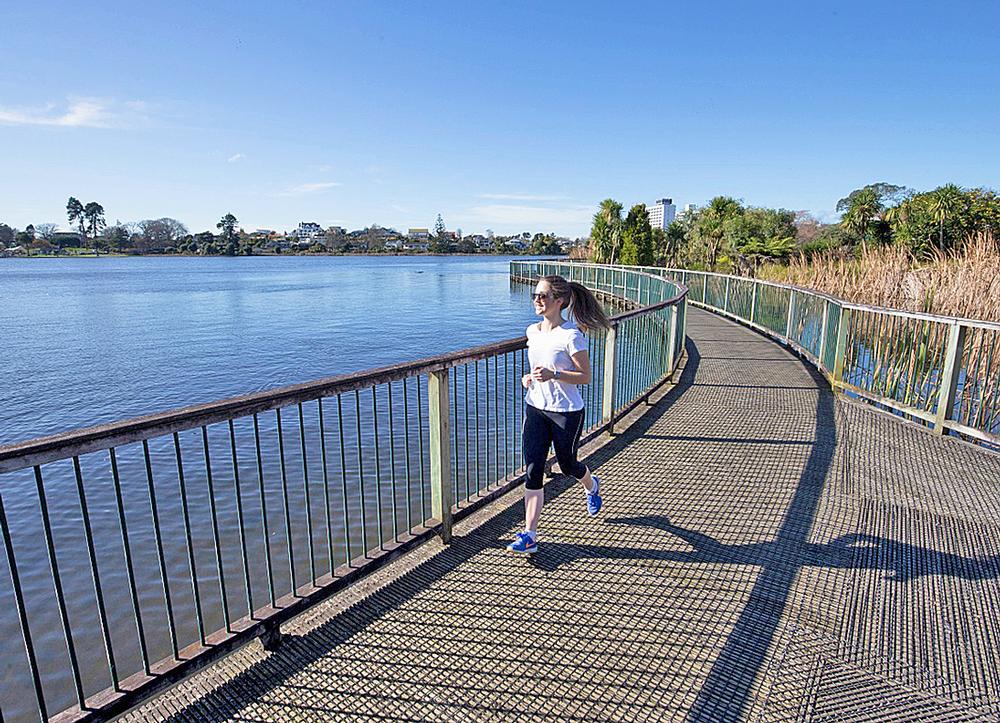
Hamilton council manages a range of infrastructure, including more than 1100 hectares of open space, two aquatic facilities and more than 1000k of off-road cycle and walkways, suburban streets and footpaths, which will be used to deliver new playful environments.

Reclaim the streets
Implementation is happening primarily through the council’s long-term plan process, which is developed every three years, with a 10-year horizon, and since the strategy was adopted, in 2019, it has informed a number of potential projects and programmes.

“Initiatives under the Play Strategy will create more opportunities for Hamiltonians to be active in spontaneous and informal ways and help to support similar work occurring in councils across the region and the rest of the country,” says Sport Waikato CEO, Matthew Cooper. “The organisation’s big hairy audacious goal is for 75 per cent of people in the region to meet the national physical activity guidelines.”

One of the main challenges is behaviour change within the organisation and also to reimagine spaces which have not traditionally contributed towards play outcomes, such as the streets.

“Streets used to be places to play and for social connection but presently the focus on streets is almost purely as a network for moving cars,” says Vervoort. “We’d like to see a return of suburban streets to being the realm of children and grown-ups engaging in play.”

Reimagining the city
According to Vervoort, the strategy has already captured the hearts and minds of the public, as well as council staff responsible for developing parks and open spaces: “The focus on play seems to prompt people to connect with their childhoods and remember how they played, which enables innovative thinking about how we might reimagine Hamilton city.”

Going forward, Cooper believes tackling the environment of cities will be vital in order to increase activity and deal with a variety of health challenges. “Cities can either build-in inactivity, through car-based development and a lack of walking and cycling infrastructure, or make it easy to be active every day, which we know has a range of physical, social, emotional and mental benefits,” he says.

“The built form in a city has a very real impact on our bodies. Decisions councils make around parks, open spaces and alternative transport options will contribute to people’s choices about walking, biking or driving a car. Connecting walkways and cycleways and open spaces to key places of employment, education and recreation makes a real difference to the health of a community.”

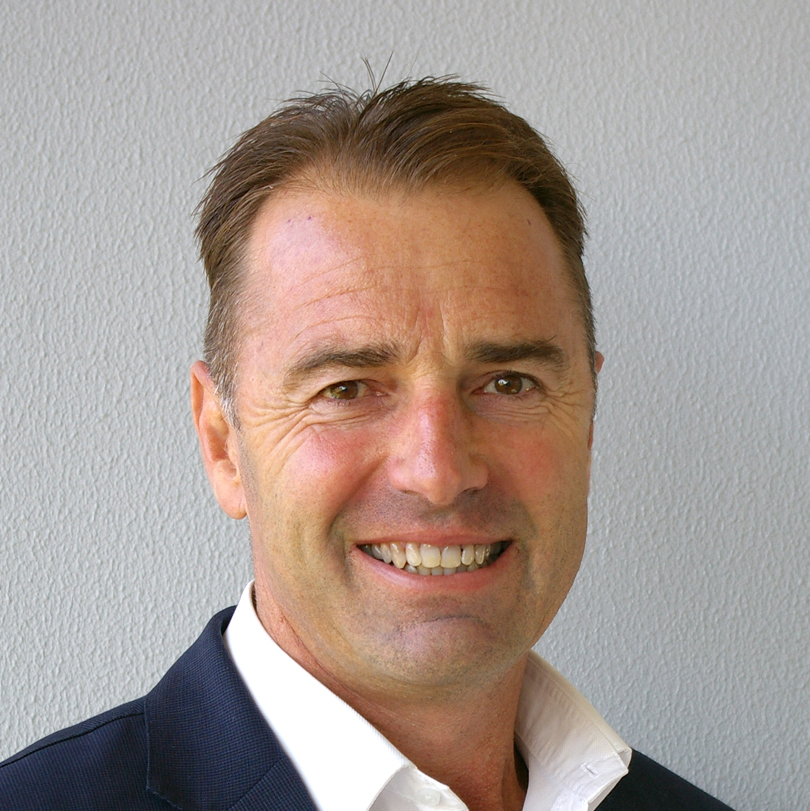
What if fun was at the centre of our strategy? Would making the city more playful support people to play more?

– Lance Vervoort, Hamilton City Council NZ

The organisation’s big hairy audacious goal is for 75 per cent of people in the region to meet the national physical activity guidelines

– Matthew Cooper, Sport Waikato

The vision

• Put Hamilton on the map as a place of joy, fun, adventure, exploration and competition

• Create safe, accessible walkways, cycleways and sports grounds, well-connected to key destinations

• Target investment at infrastructure to encourage all demographics to play

• Communicate with the community, so they understand play isn’t just about playgrounds but about having physical fun and adventure wherever they are

• Offer a wide range of opportunities for elite sportspeople, club level participants and young people to engage easily in organised sport

• For sports clubs to contribute to this

• For Hamiltonians to increase their participation in physical activity

• For the barriers to participation to reduce and the disparity between population groups decrease

Sign up here to get Fit Tech's weekly ezine and every issue of Fit Tech magazine free on digital.
Gallery
More features
Editor's letter

Into the fitaverse

Fitness is already among the top three markets in the metaverse, with new technology and partnerships driving real growth and consumer engagement that looks likely to spill over into health clubs, gyms and studios
Fit Tech people

Ali Jawad

Paralympic powerlifter and founder, Accessercise
Users can easily identify which facilities in the UK are accessible to the disabled community
Fit Tech people

Hannes Sjöblad

MD, DSruptive
We want to give our users an implantable tool that allows them to collect their health data at any time and in any setting
Fit Tech people

Jamie Buck

Co-founder, Active in Time
We created a solution called AiT Voice, which turns digital data into a spoken audio timetable that connects to phone systems
Profile

Fahad Alhagbani: reinventing fitness

Let’s live in the future to improve today
Opinion

Building on the blockchain

For small sports teams looking to compete with giants, blockchain can be a secret weapon explains Lars Rensing, CEO of Protokol
Innovation

Bold move

Our results showed a greater than 60 per cent reduction in falls for individuals who actively participated in Bold’s programme
App analysis

Check your form

Sency’s motion analysis technology is allowing users to check their technique as they exercise. Co-founder and CEO Gal Rotman explains how
Profile

New reality

Sam Cole, CEO of FitXR, talks to Fit Tech about taking digital workouts to the next level, with an immersive, virtual reality fitness club
Profile

Sohail Rashid

35 million people a week participate in strength training. We want Brawn to help this audience achieve their goals
Ageing

Reverse Ageing

Many apps help people track their health, but Humanity founders Peter Ward and Michael Geer have put the focus on ageing, to help users to see the direct repercussions of their habits. They talk to Steph Eaves
App analysis

Going hybrid

Workout Anytime created its app in partnership with Virtuagym. Workout Anytime’s Greg Maurer and Virtuagym’s Hugo Braam explain the process behind its creation
Research

Physical activity monitors boost activity levels

Researchers at the University of Copenhagen have conducted a meta analysis of all relevant research and found that the body of evidence shows an impact
Editor's letter

Two-way coaching

Content providers have been hugely active in the fit tech market since the start of the pandemic. We expect the industry to move on from delivering these services on a ‘broadcast-only’ basis as two-way coaching becomes the new USP
Fit Tech People

Laurent Petit

Co-founder, Active Giving
The future of sports and fitness are dependent on the climate. Our goal is to positively influence the future of our planet by instilling a global vision of wellbeing and a sense of collective action
Fit Tech People

Adam Zeitsiff

CEO, Intelivideo
We don’t just create the technology and bail – we support our clients’ ongoing hybridisation efforts
Fit Tech People

Anantharaman Pattabiraman

CEO and co-founder, Auro
When you’re undertaking fitness activities, unless you’re on a stationary bike, in most cases it’s not safe or necessary to be tied to a screen, especially a small screen
Fit Tech People

Mike Hansen

Managing partner, Endorphinz
We noticed a big gap in the market – customers needed better insights but also recommendations on what to do, whether that be customer acquisition, content creation, marketing and more
More features
Technogym provides a complete Ecosystem made of connected smart fitness equipment, digital services and training ...
Every week, millions of people get fit in 21,000 clubs, across 100 countries with the ...
22-23 Sep 2026
Four Seasons Hotel Bangkok at Chao Phraya River, Bangkok , Thailand
Technogym provides a complete Ecosystem made of connected smart fitness equipment, digital services and training ...
Every week, millions of people get fit in 21,000 clubs, across 100 countries with the ...
Get Fit Tech
Sign up for the free Fit Tech ezine and breaking news alerts
Sign up
22-23 Sep 2026
Four Seasons Hotel Bangkok at Chao Phraya River, Bangkok , Thailand

latest fit tech news

PureGym is encouraging people to step away from their screens and go for a walk, in a new initiative timed ...
news • 29 May 2026
Active people app, Strava, has overhauled its strength training experience, allowing gym-goers to automatically log and share their lifts from ...
news • 27 May 2026

Fitness First UK is embracing digital wellness technology by installing Kip’s tap-to-activate phone controls across its UK estate. Kip tags ...
news • 22 May 2026
The world’s first awareness ring has been launched. Designed to promote presence, focus and calm via gentle haptic vibrations, the ...
news • 13 May 2026
Center Parcs’ Aqua Sana Forest Spa, Woburn Forest, UK, has transformed an unused space into a touchless wellness area called ...
news • 12 May 2026
Gharieni Group has launched a new company, Cobotics Innovations, to create automated wellness experiences. The first solution is a robotic ...
product innovation • 07 May 2026

US-based robotics wellness company Aescape Inc has entered insolvency proceedings following the sale of substantially all of its ...

news • 06 May 2026
Fitness platform, Zing Coach, has teamed up with Les Mills, in a partnership that gives its users access to group ...
news • 23 Apr 2026

TMActive is launching a new Active Wellbeing Studio next month in Tonbridge, UK, specifically aimed at people who face higher ...
news • 13 Apr 2026

Indian billionaire, Deepinder Goyal, is working on a device called Temple that aims to track blood flow to the brain ...
news • 10 Apr 2026
More fit tech news
features

Town planning: Play full city

Over time, town planning has led to the creation of obesogenic environments, but Hamilton in New Zealand is taking a fresh approach to mobilising its population, by turning the city into a playground, as Kath Hudson reports

Published in Health Club Management 2021 issue 4

Underpasses becoming climbing walls, community access to school facilities, better integrated cycling and walking infrastructure and a mobile play trailer are all being considered by Hamilton City Council as ways of giving the city an injection of fun and encouraging people to travel by bike or on foot.

The city, in the Waikato region of the North Island – famous as the location of Middle Earth and The Shire, in The Lord of the Rings – is blessed with beautiful natural resources and an active population, but is still grappling with increases in obesity levels.

The New Zealand Health Survey 2019/20 found that one in three adults aged 15 and over were obese (30.9 per cent), with the prevalence of obesity differing with ethnicity: being 63.4 per cent in Pacific Islanders, 47.9 per cent in Maoris, 29.3 per cent in European/other and 15.9 per cent in Asians.

National activity guidelines in New Zealand are for adults to do 150 minutes of moderate exercise or 75 minutes of vigorous exercise throughout the week, but to double this for extra health benefits.

Having spent time living in New Zealand during the early noughties, it was great to see how much time people spent being active outdoors. This was thanks largely to the magnificent natural environment and the energetic Kiwi mindset, but government encouragement played a part too. The jingle from a public health advert still sticks in my mind, reminding me to “push play for 30 minutes a day.”

This belief in play being good for you has now been put at the heart of a sports and recreation strategy devised by Hamilton City Council, in consultation with the public, local sports clubs and other stakeholders, including Sport Waikato, which promotes play, active recreation and sport throughout the Waikato region.

The Play Strategy aims to boost physical activity levels by providing playful opportunities around the city for everyone and in so doing, transforming Hamilton into New Zealand’s most playable city.

Three different types of play are defined under the strategy: spontaneous play, organised sport and informal recreation.

Exercise should be fun
A review of Hamilton’s sports and recreation strategy, carried out in 2018, revealed two key findings: firstly that participation in organised sport – both in the city and nationally – was declining and although people understood the health benefits of physical activity, this wasn’t always translating into action; secondly, while participation in organised sport was declining, it was actually increasing in informal recreation.

The research also showed that 52 per cent of participants will only do physical activity if it’s fun – rising to 62 per cent among those aged five to 17 and that council assets, such as roads, walkways, public parks, fields and playgrounds, were the most common places for people to be physically active.

“This begged the question: what if we focus on play and fun for all ages?” says Hamilton City Council general manager community, Lance Vervoort. “What if fun was at the centre of our strategy and achieving the physical activity guidelines was a by product of fun? Would making the city more playful support people to play more?

“These questions provided a change in mindset, which enabled staff to focus on play for everyone and to reframe council assets such as walkways, street trees, open spaces, gullies, sports parks, aquatic facilities, footpaths and streets as play infrastructure where people can engage in physical movement and fun.”

Hamilton council manages a range of infrastructure, including more than 1100 hectares of open space, two aquatic facilities and more than 1000k of off-road cycle and walkways, suburban streets and footpaths, which will be used to deliver new playful environments.

Reclaim the streets
Implementation is happening primarily through the council’s long-term plan process, which is developed every three years, with a 10-year horizon, and since the strategy was adopted, in 2019, it has informed a number of potential projects and programmes.

“Initiatives under the Play Strategy will create more opportunities for Hamiltonians to be active in spontaneous and informal ways and help to support similar work occurring in councils across the region and the rest of the country,” says Sport Waikato CEO, Matthew Cooper. “The organisation’s big hairy audacious goal is for 75 per cent of people in the region to meet the national physical activity guidelines.”

One of the main challenges is behaviour change within the organisation and also to reimagine spaces which have not traditionally contributed towards play outcomes, such as the streets.

“Streets used to be places to play and for social connection but presently the focus on streets is almost purely as a network for moving cars,” says Vervoort. “We’d like to see a return of suburban streets to being the realm of children and grown-ups engaging in play.”

Reimagining the city
According to Vervoort, the strategy has already captured the hearts and minds of the public, as well as council staff responsible for developing parks and open spaces: “The focus on play seems to prompt people to connect with their childhoods and remember how they played, which enables innovative thinking about how we might reimagine Hamilton city.”

Going forward, Cooper believes tackling the environment of cities will be vital in order to increase activity and deal with a variety of health challenges. “Cities can either build-in inactivity, through car-based development and a lack of walking and cycling infrastructure, or make it easy to be active every day, which we know has a range of physical, social, emotional and mental benefits,” he says.

“The built form in a city has a very real impact on our bodies. Decisions councils make around parks, open spaces and alternative transport options will contribute to people’s choices about walking, biking or driving a car. Connecting walkways and cycleways and open spaces to key places of employment, education and recreation makes a real difference to the health of a community.”
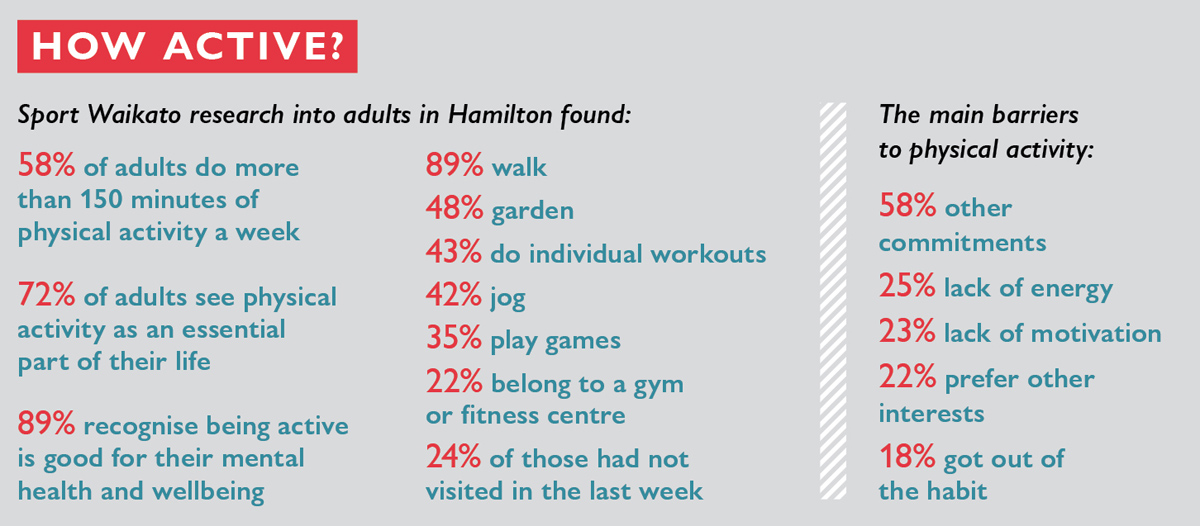
What if fun was at the centre of our strategy? Would making the city more playful support people to play more?

– Lance Vervoort, Hamilton City Council NZ

The organisation’s big hairy audacious goal is for 75 per cent of people in the region to meet the national physical activity guidelines

– Matthew Cooper, Sport Waikato

The vision

• Put Hamilton on the map as a place of joy, fun, adventure, exploration and competition

• Create safe, accessible walkways, cycleways and sports grounds, well-connected to key destinations

• Target investment at infrastructure to encourage all demographics to play

• Communicate with the community, so they understand play isn’t just about playgrounds but about having physical fun and adventure wherever they are

• Offer a wide range of opportunities for elite sportspeople, club level participants and young people to engage easily in organised sport

• For sports clubs to contribute to this

• For Hamiltonians to increase their participation in physical activity

• For the barriers to participation to reduce and the disparity between population groups decrease

Sign up here to get Fit Tech's weekly ezine and every issue of Fit Tech magazine free on digital.
Gallery
More features
Editor's letter

Into the fitaverse

Fitness is already among the top three markets in the metaverse, with new technology and partnerships driving real growth and consumer engagement that looks likely to spill over into health clubs, gyms and studios
Fit Tech people

Ali Jawad

Paralympic powerlifter and founder, Accessercise
Users can easily identify which facilities in the UK are accessible to the disabled community
Fit Tech people

Hannes Sjöblad

MD, DSruptive
We want to give our users an implantable tool that allows them to collect their health data at any time and in any setting
Fit Tech people

Jamie Buck

Co-founder, Active in Time
We created a solution called AiT Voice, which turns digital data into a spoken audio timetable that connects to phone systems
Profile

Fahad Alhagbani: reinventing fitness

Let’s live in the future to improve today
Opinion

Building on the blockchain

For small sports teams looking to compete with giants, blockchain can be a secret weapon explains Lars Rensing, CEO of Protokol
Innovation

Bold move

Our results showed a greater than 60 per cent reduction in falls for individuals who actively participated in Bold’s programme
App analysis

Check your form

Sency’s motion analysis technology is allowing users to check their technique as they exercise. Co-founder and CEO Gal Rotman explains how
Profile

New reality

Sam Cole, CEO of FitXR, talks to Fit Tech about taking digital workouts to the next level, with an immersive, virtual reality fitness club
Profile

Sohail Rashid

35 million people a week participate in strength training. We want Brawn to help this audience achieve their goals
Ageing

Reverse Ageing

Many apps help people track their health, but Humanity founders Peter Ward and Michael Geer have put the focus on ageing, to help users to see the direct repercussions of their habits. They talk to Steph Eaves
App analysis

Going hybrid

Workout Anytime created its app in partnership with Virtuagym. Workout Anytime’s Greg Maurer and Virtuagym’s Hugo Braam explain the process behind its creation
Research

Physical activity monitors boost activity levels

Researchers at the University of Copenhagen have conducted a meta analysis of all relevant research and found that the body of evidence shows an impact
Editor's letter

Two-way coaching

Content providers have been hugely active in the fit tech market since the start of the pandemic. We expect the industry to move on from delivering these services on a ‘broadcast-only’ basis as two-way coaching becomes the new USP
Fit Tech People

Laurent Petit

Co-founder, Active Giving
The future of sports and fitness are dependent on the climate. Our goal is to positively influence the future of our planet by instilling a global vision of wellbeing and a sense of collective action
Fit Tech People

Adam Zeitsiff

CEO, Intelivideo
We don’t just create the technology and bail – we support our clients’ ongoing hybridisation efforts
Fit Tech People

Anantharaman Pattabiraman

CEO and co-founder, Auro
When you’re undertaking fitness activities, unless you’re on a stationary bike, in most cases it’s not safe or necessary to be tied to a screen, especially a small screen
Fit Tech People

Mike Hansen

Managing partner, Endorphinz
We noticed a big gap in the market – customers needed better insights but also recommendations on what to do, whether that be customer acquisition, content creation, marketing and more
More features