




The Leisure Media Company Ltd | Fit Tech promotion
features

Research round-up: Fit together

EMD UK’s Marcus Kingwell talks about the value and far-reaching impact of group exercise classes. It’s time to invest to get the best!

Published in Health Club Handbook 2020 issue 1

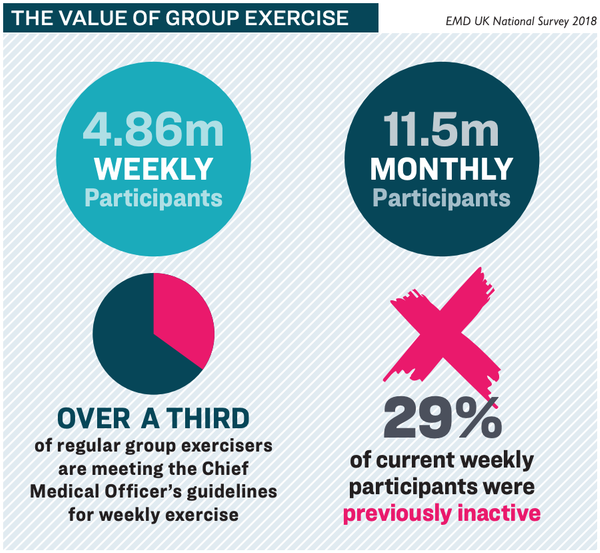
As the national governing body for group exercise, EMD UK are committed to growing participation in the activity. Currently 4.86 million people take part every week and this number is growing rapidly with over one million more weekly participants since 2016.

With the upward trend in group exercise set to continue, the need for a qualified, highly skilled workforce is paramount for the safety of participants and sector growth.

In 2019, EMD UK worked in partnership with Active IQ to revamp the Exercise to Music qualification for the 21st century. The qualification, which had remained widely untouched since the 1990s, has been updated to reflect the changing fitness landscape and is now delivered under the name Level 2 Group Training to Music.

The national governing body also works with operators and boutiques, recently Third Space London, to upskill staff and review timetables, ensuring the best possible group exercise experience is being delivered to members and that the workforce is happy.

Sweating Your Assets
In 2019, EMD UK published their white paper at the Elevate conference. Entitled Sweating Your Assets: The Value of Group Exercise, the report highlights the growth of this popular activity and demonstrates how it’s moved inactive people into a regular physical activity habit.

It showcases the contribution that group exercise has made in creating a healthier nation through exercise but also notes that the activity is widely undervalued as a gateway to active lives, not just by the public but also by the fitness industry.

Group Together
Group exercise, or group fitness classes as they are also known, are a familiar sight in gyms, leisure centres, studios, and village and community halls.

With a range of classes to choose from, such as Pilates, dance fitness and boot camps, group exercise provides an accessible activity for those looking to start a regular exercise routine; one reason why it has featured heavily in Sport England’s This Girl Can campaign.

A large problem currently facing the UK is that of inactivity. The Chief Medical Officer’s physical activity guidelines state that adults should participate in 150 minutes of moderate intensity exercise every week. To be classed as inactive, a person is doing 30 minutes or less activity every week.

In 2017, a study by the British Heart Foundation found that more than 20 million people in the UK were found to be physically inactive.

With inactivity thought to be more deadly than smoking, much more needs to be done to get people healthier. Group exercise has been proven as a gateway to physical activity. In fact, 29 per cent of current group exercise participants were inactive before they started to participate in group activity classes and 55 per cent of those had been inactive for three years or longer.

Combat Loneliness
Aside from the physical health benefits, group exercise promotes a wealth of mental and social benefits. There’s been widespread coverage about the UK’s current loneliness epidemic and it’s not just the elderly who are prone to feelings of isolation or being alone.

Figures published in April 2018 from the Office of National Statistics (ONS) revealed that more than five per cent of adults in England felt lonely “often” or “always” between 2016 and 2017 (that’s one in every 20 adults), with 16 per cent enduring feelings of loneliness sometimes, and 24 per cent occasionally.

Group exercise classes are more than just loud music, fast movements, and shouts of encouragement from an instructor at the front of a class. They also offer fantastic social inclusion opportunities, health benefits and psychological support – all imperative to combat loneliness.

The group setting really helps people develop a sense of community, truly feeling they are a part of something by being surrounded by like-minded, encouraging people, many of whom will have similar ambitions and reasons for joining.

Promote Group Exercise
Despite the merits of group exercise and the growing number of people participating, EMD UK argue that more needs to be done to promote the value of group exercise to wider society, and that health club operators have a key role to play.

Group exercise is often an afterthought in leisure centre membership promotions, where the marketing line “free classes included” frequently and instantly undervalues the activity. Many leisure and fitness operators are under pressure to reduce costs and offer cheaper services.

Cuts to local authority budgets, the rise of the budget gym chains and growing competition for leisure spend mean the fitness marketplace is as competitive as it’s ever been.

However, group exercise can strengthen a gym’s membership retention. A 2013 study by The Retention People found that people who attend group exercise classes are 26 per cent less likely to cancel their gym membership. For this reason, and others outlined in Sweating Your Assets, health club operators and leisure providers must do more to promote the value of group exercise to their local communities to create healthier, more active people. With the advent of social prescribing becoming more prevalent to lessen the burden on the NHS, leisure facilities can welcome more new customers. As an alternative solution for medical rehabilitation, these new participants have a genuine interest in attending the exercise classes on a regular basis.

Value Your Instructors
Investment in group exercise and its workforce is key to promoting positive activity changes in society. EMD UK have identified that the group exercise workforce is also endemically undervalued.

Instructors are the second biggest influencer on group exercise attendance and the face of the activity. Despite their work in helping people to get active, many instructors have not had a pay rise in over ten years. Investing in instructor pay, CPD and understanding the value group exercise brings to their business are ways that health club operators can raise the profile of group exercise for the good of the nation.

As an activity, the benefits of group exercise are far reaching. It’s not just the individual participants who profit from better physical health, but wider society; increased mental welfare, lower stress, the opportunity to meet new people, fewer sick days, a reason to leave the house – all culminate in a healthier, more active society which is less dependent on social care.

As the national governing body for group exercise, we are calling on the public, local authorities, health club operators, the workforce and the industry to recognise the value of group exercise.

With one million more people participating since 2016, many more inactive people will convert to a regular physical activity habit. With a whole-system approach, we can achieve a healthier nation through exercise and Sweating Your Assets marks the start of this challenge for EMD UK.

Marcus Kingwell is CEO of EMD UK – the national governing body for group exercise.

emduk.org

Sweating Your Assets is available to download here.

Sign up here to get Fit Tech's weekly ezine and every issue of Fit Tech magazine free on digital.
Gallery
More features
Editor's letter

Into the fitaverse

Fitness is already among the top three markets in the metaverse, with new technology and partnerships driving real growth and consumer engagement that looks likely to spill over into health clubs, gyms and studios
Fit Tech people

Ali Jawad

Paralympic powerlifter and founder, Accessercise
Users can easily identify which facilities in the UK are accessible to the disabled community
Fit Tech people

Hannes Sjöblad

MD, DSruptive
We want to give our users an implantable tool that allows them to collect their health data at any time and in any setting
Fit Tech people

Jamie Buck

Co-founder, Active in Time
We created a solution called AiT Voice, which turns digital data into a spoken audio timetable that connects to phone systems
Profile

Fahad Alhagbani: reinventing fitness

The team is young and ambitious, and the awareness of technology is very high. We share trends and out-of-the-box ideas almost every day
Opinion

Building on the blockchain

For small sports teams looking to compete with giants, blockchain can be a secret weapon explains Lars Rensing, CEO of Protokol
Innovation

Bold move

Our results showed a greater than 60 per cent reduction in falls for individuals who actively participated in Bold’s programme
App analysis

Check your form

Sency’s motion analysis technology is allowing users to check their technique as they exercise. Co-founder and CEO Gal Rotman explains how
Profile

New reality

Sam Cole, CEO of FitXR, talks to Fit Tech about taking digital workouts to the next level, with an immersive, virtual reality fitness club
Profile

Sohail Rashid

The app is free and it’s $40 to participate in one of our virtual events
Ageing

Reverse Ageing

Many apps help people track their health, but Humanity founders Peter Ward and Michael Geer have put the focus on ageing, to help users to see the direct repercussions of their habits. They talk to Steph Eaves
App analysis

Going hybrid

Workout Anytime created its app in partnership with Virtuagym. Workout Anytime’s Greg Maurer and Virtuagym’s Hugo Braam explain the process behind its creation
Research

Physical activity monitors boost activity levels

Researchers at the University of Copenhagen have conducted a meta analysis of all relevant research and found that the body of evidence shows an impact
Editor's letter

Two-way coaching

Content providers have been hugely active in the fit tech market since the start of the pandemic. We expect the industry to move on from delivering these services on a ‘broadcast-only’ basis as two-way coaching becomes the new USP
Fit Tech People

Laurent Petit

Co-founder, Active Giving
The future of sports and fitness are dependent on the climate. Our goal is to positively influence the future of our planet by instilling a global vision of wellbeing and a sense of collective action
Fit Tech People

Adam Zeitsiff

CEO, Intelivideo
We don’t just create the technology and bail – we support our clients’ ongoing hybridisation efforts
Fit Tech People

Anantharaman Pattabiraman

CEO and co-founder, Auro
When you’re undertaking fitness activities, unless you’re on a stationary bike, in most cases it’s not safe or necessary to be tied to a screen, especially a small screen
Fit Tech People

Mike Hansen

Managing partner, Endorphinz
We noticed a big gap in the market – customers needed better insights but also recommendations on what to do, whether that be customer acquisition, content creation, marketing and more
More features
Taylor Made Designs offer health clubs a fully-managed end-to-end service. From garment design to sourcing, ...
Perfect Gym, part of the Sport Alliance group, is a global software provider specialising in ...
22-23 Sep 2026
Four Seasons Hotel Bangkok at Chao Phraya River, Bangkok , Thailand
Taylor Made Designs offer health clubs a fully-managed end-to-end service. From garment design to sourcing, ...
Perfect Gym, part of the Sport Alliance group, is a global software provider specialising in ...
Get Fit Tech
Sign up for the free Fit Tech ezine and breaking news alerts
Sign up
22-23 Sep 2026
Four Seasons Hotel Bangkok at Chao Phraya River, Bangkok , Thailand

latest fit tech news

PureGym is encouraging people to step away from their screens and go for a walk, in a new initiative timed ...
news • 29 May 2026
Active people app, Strava, has overhauled its strength training experience, allowing gym-goers to automatically log and share their lifts from ...
news • 27 May 2026

Fitness First UK is embracing digital wellness technology by installing Kip’s tap-to-activate phone controls across its UK estate. Kip tags ...
news • 22 May 2026
The world’s first awareness ring has been launched. Designed to promote presence, focus and calm via gentle haptic vibrations, the ...
news • 13 May 2026
Center Parcs’ Aqua Sana Forest Spa, Woburn Forest, UK, has transformed an unused space into a touchless wellness area called ...
news • 12 May 2026
Gharieni Group has launched a new company, Cobotics Innovations, to create automated wellness experiences. The first solution is a robotic ...
product innovation • 07 May 2026

US-based robotics wellness company Aescape Inc has entered insolvency proceedings following the sale of substantially all of its ...

news • 06 May 2026
Fitness platform, Zing Coach, has teamed up with Les Mills, in a partnership that gives its users access to group ...
news • 23 Apr 2026

TMActive is launching a new Active Wellbeing Studio next month in Tonbridge, UK, specifically aimed at people who face higher ...
news • 13 Apr 2026

Indian billionaire, Deepinder Goyal, is working on a device called Temple that aims to track blood flow to the brain ...
news • 10 Apr 2026
More fit tech news
features

Research round-up: Fit together

EMD UK’s Marcus Kingwell talks about the value and far-reaching impact of group exercise classes. It’s time to invest to get the best!

Published in Health Club Handbook 2020 issue 1

As the national governing body for group exercise, EMD UK are committed to growing participation in the activity. Currently 4.86 million people take part every week and this number is growing rapidly with over one million more weekly participants since 2016.

With the upward trend in group exercise set to continue, the need for a qualified, highly skilled workforce is paramount for the safety of participants and sector growth.

In 2019, EMD UK worked in partnership with Active IQ to revamp the Exercise to Music qualification for the 21st century. The qualification, which had remained widely untouched since the 1990s, has been updated to reflect the changing fitness landscape and is now delivered under the name Level 2 Group Training to Music.

The national governing body also works with operators and boutiques, recently Third Space London, to upskill staff and review timetables, ensuring the best possible group exercise experience is being delivered to members and that the workforce is happy.

Sweating Your Assets
In 2019, EMD UK published their white paper at the Elevate conference. Entitled Sweating Your Assets: The Value of Group Exercise, the report highlights the growth of this popular activity and demonstrates how it’s moved inactive people into a regular physical activity habit.

It showcases the contribution that group exercise has made in creating a healthier nation through exercise but also notes that the activity is widely undervalued as a gateway to active lives, not just by the public but also by the fitness industry.

Group Together
Group exercise, or group fitness classes as they are also known, are a familiar sight in gyms, leisure centres, studios, and village and community halls.

With a range of classes to choose from, such as Pilates, dance fitness and boot camps, group exercise provides an accessible activity for those looking to start a regular exercise routine; one reason why it has featured heavily in Sport England’s This Girl Can campaign.

A large problem currently facing the UK is that of inactivity. The Chief Medical Officer’s physical activity guidelines state that adults should participate in 150 minutes of moderate intensity exercise every week. To be classed as inactive, a person is doing 30 minutes or less activity every week.

In 2017, a study by the British Heart Foundation found that more than 20 million people in the UK were found to be physically inactive.

With inactivity thought to be more deadly than smoking, much more needs to be done to get people healthier. Group exercise has been proven as a gateway to physical activity. In fact, 29 per cent of current group exercise participants were inactive before they started to participate in group activity classes and 55 per cent of those had been inactive for three years or longer.

Combat Loneliness
Aside from the physical health benefits, group exercise promotes a wealth of mental and social benefits. There’s been widespread coverage about the UK’s current loneliness epidemic and it’s not just the elderly who are prone to feelings of isolation or being alone.

Figures published in April 2018 from the Office of National Statistics (ONS) revealed that more than five per cent of adults in England felt lonely “often” or “always” between 2016 and 2017 (that’s one in every 20 adults), with 16 per cent enduring feelings of loneliness sometimes, and 24 per cent occasionally.

Group exercise classes are more than just loud music, fast movements, and shouts of encouragement from an instructor at the front of a class. They also offer fantastic social inclusion opportunities, health benefits and psychological support – all imperative to combat loneliness.

The group setting really helps people develop a sense of community, truly feeling they are a part of something by being surrounded by like-minded, encouraging people, many of whom will have similar ambitions and reasons for joining.

Promote Group Exercise
Despite the merits of group exercise and the growing number of people participating, EMD UK argue that more needs to be done to promote the value of group exercise to wider society, and that health club operators have a key role to play.

Group exercise is often an afterthought in leisure centre membership promotions, where the marketing line “free classes included” frequently and instantly undervalues the activity. Many leisure and fitness operators are under pressure to reduce costs and offer cheaper services.

Cuts to local authority budgets, the rise of the budget gym chains and growing competition for leisure spend mean the fitness marketplace is as competitive as it’s ever been.

However, group exercise can strengthen a gym’s membership retention. A 2013 study by The Retention People found that people who attend group exercise classes are 26 per cent less likely to cancel their gym membership. For this reason, and others outlined in Sweating Your Assets, health club operators and leisure providers must do more to promote the value of group exercise to their local communities to create healthier, more active people. With the advent of social prescribing becoming more prevalent to lessen the burden on the NHS, leisure facilities can welcome more new customers. As an alternative solution for medical rehabilitation, these new participants have a genuine interest in attending the exercise classes on a regular basis.

Value Your Instructors
Investment in group exercise and its workforce is key to promoting positive activity changes in society. EMD UK have identified that the group exercise workforce is also endemically undervalued.

Instructors are the second biggest influencer on group exercise attendance and the face of the activity. Despite their work in helping people to get active, many instructors have not had a pay rise in over ten years. Investing in instructor pay, CPD and understanding the value group exercise brings to their business are ways that health club operators can raise the profile of group exercise for the good of the nation.

As an activity, the benefits of group exercise are far reaching. It’s not just the individual participants who profit from better physical health, but wider society; increased mental welfare, lower stress, the opportunity to meet new people, fewer sick days, a reason to leave the house – all culminate in a healthier, more active society which is less dependent on social care.

As the national governing body for group exercise, we are calling on the public, local authorities, health club operators, the workforce and the industry to recognise the value of group exercise.

With one million more people participating since 2016, many more inactive people will convert to a regular physical activity habit. With a whole-system approach, we can achieve a healthier nation through exercise and Sweating Your Assets marks the start of this challenge for EMD UK.

Marcus Kingwell is CEO of EMD UK – the national governing body for group exercise.

emduk.org

Sweating Your Assets is available to download here.

Sign up here to get Fit Tech's weekly ezine and every issue of Fit Tech magazine free on digital.
Gallery
More features
Editor's letter

Into the fitaverse

Fitness is already among the top three markets in the metaverse, with new technology and partnerships driving real growth and consumer engagement that looks likely to spill over into health clubs, gyms and studios
Fit Tech people

Ali Jawad

Paralympic powerlifter and founder, Accessercise
Users can easily identify which facilities in the UK are accessible to the disabled community
Fit Tech people

Hannes Sjöblad

MD, DSruptive
We want to give our users an implantable tool that allows them to collect their health data at any time and in any setting
Fit Tech people

Jamie Buck

Co-founder, Active in Time
We created a solution called AiT Voice, which turns digital data into a spoken audio timetable that connects to phone systems
Profile

Fahad Alhagbani: reinventing fitness

The team is young and ambitious, and the awareness of technology is very high. We share trends and out-of-the-box ideas almost every day
Opinion

Building on the blockchain

For small sports teams looking to compete with giants, blockchain can be a secret weapon explains Lars Rensing, CEO of Protokol
Innovation

Bold move

Our results showed a greater than 60 per cent reduction in falls for individuals who actively participated in Bold’s programme
App analysis

Check your form

Sency’s motion analysis technology is allowing users to check their technique as they exercise. Co-founder and CEO Gal Rotman explains how
Profile

New reality

Sam Cole, CEO of FitXR, talks to Fit Tech about taking digital workouts to the next level, with an immersive, virtual reality fitness club
Profile

Sohail Rashid

The app is free and it’s $40 to participate in one of our virtual events
Ageing

Reverse Ageing

Many apps help people track their health, but Humanity founders Peter Ward and Michael Geer have put the focus on ageing, to help users to see the direct repercussions of their habits. They talk to Steph Eaves
App analysis

Going hybrid

Workout Anytime created its app in partnership with Virtuagym. Workout Anytime’s Greg Maurer and Virtuagym’s Hugo Braam explain the process behind its creation
Research

Physical activity monitors boost activity levels

Researchers at the University of Copenhagen have conducted a meta analysis of all relevant research and found that the body of evidence shows an impact
Editor's letter

Two-way coaching

Content providers have been hugely active in the fit tech market since the start of the pandemic. We expect the industry to move on from delivering these services on a ‘broadcast-only’ basis as two-way coaching becomes the new USP
Fit Tech People

Laurent Petit

Co-founder, Active Giving
The future of sports and fitness are dependent on the climate. Our goal is to positively influence the future of our planet by instilling a global vision of wellbeing and a sense of collective action
Fit Tech People

Adam Zeitsiff

CEO, Intelivideo
We don’t just create the technology and bail – we support our clients’ ongoing hybridisation efforts
Fit Tech People

Anantharaman Pattabiraman

CEO and co-founder, Auro
When you’re undertaking fitness activities, unless you’re on a stationary bike, in most cases it’s not safe or necessary to be tied to a screen, especially a small screen
Fit Tech People

Mike Hansen

Managing partner, Endorphinz
We noticed a big gap in the market – customers needed better insights but also recommendations on what to do, whether that be customer acquisition, content creation, marketing and more
More features