







features

Feedback: HCM Forum

Fuel the debate about issues and opportunities across the industry. We’d love to hear from you. Write to [email protected]

Published in Health Club Management 2026 issue 2

Alex Lucas, Research manager, UK Active
Alex Lucas, Research manager, UK Active / Alex Lucas
UK Active’s work with insight firm Beano Brain casts light on Gen Alpha
Alex Lucas, Research manager, UK Active

We welcome the recent feature in HCM on Gen Alpha which showed a strong focus by operators across our sector in engaging the next generation (HCM issue 1 2026, p72).

Gen Alpha represents about 11.75 million people or 17 per cent of the UK population, making it an important audience for our sector as current and future users of our facilities.

Over the past six years there’s been a 12 per cent rise in the number of children and young people getting active and understanding this generation’s motivations is vital to ensure our sector is ready to welcome them.

UK Active conducted polling with family insight agency Beano Brain, which found 40 per cent of children aged seven to 14 want to be more physically active and almost half (49 per cent) said they’d like to be fit and healthy as adults.

Our findings also revealed what helps Gen Alpha enjoy being active, with top factors being ‘taking part in activities with friends’ (63 per cent), ‘having a friendly and supportive coach’ (46 per cent) and ‘being in a familiar place’ (42 per cent). This shows the importance that a social, supportive and familiar environment plays in supporting children’s activity.

Gen Alpha represents about 11.75 million people or 17 per cent of the UK  population, making it an important audience for our sector

Insight from UK Active’s recent qualitative evaluation of the Opening School Facilities programme mirrors these findings. Through this programme, schools and leisure facilities built relationships to enable access to activities outside school.

Through focused interviews, we found children built the confidence to use leisure facilities and gyms by being able to access them earlier in life. They were also more likely to enjoy being active in these settings if they were supported with a social community, relaxed environment and friendly, supportive coaches.

40 per cent of children aged seven to 14 want to be more physically active

Next steps for operators

This data provides insight into how operators can improve, adapt or refine their programmes to support participation. Simple steps can be taken to welcome these age groups into our facilities and we encourage operators to use UK Active’s new guidance, Children and young people in gym and group exercise facilities to guide decision-making.

Early, positive experiences with physical activity are vital to children’s healthy development and to building lifelong habits. The physical literacy consensus for England – a statement which provides a shared understanding of why physical activity matters and how it can be developed and supported – highlights that the way children feel when they’re active, who they’re active with and the spaces they’re active in influence their experience and relationship with exercise.

It’s more important than ever that the next generation builds a lasting relationship with physical activity and our sector is ready to play its part in creating lifelong exercise habits.

David Joerring, founder and CEO, HealthKey
David Joerring, founder and CEO, HealthKey / David Joerring
Venturing into the clinical: what GLP-1s mean for operators
David Joerring, founder and CEO, HealthKey

I read your editor’s letter on sector trends with interest, particularly the growing visibility of GLP-1s in the fitness environment – from PT education to operators directly offering access to medication.

It’s clear that GLP-1s can support positive outcomes when used appropriately, alongside training, nutrition and behaviour change.

Working with operators who are introducing GLP-1 programmes, I’m struck by the clear shift it represents into genuinely clinical territory. This creates opportunity, but also a level of responsibility many operators haven’t historically had to carry.

Once a health club engages with clinical interventions, such as weight-management medication and diagnostics, it’s no longer just about member engagement or growth. It’s about clinical governance, provider-vetting, safeguarding and the quality and continuity of care. Getting this wrong carries reputational and operational risk.

The challenge for operators isn’t so much whether to engage, it’s more about how to do so responsibly, while upholding trust and driving long-term results.

Clinical engagement is not a shortcut to growth. It’s a discipline in its own right

This is achieved by introducing the correct wraparound care and building experiences that are coherent, safe and aligned with their brand.

This is where we see a growing need for infrastructure, not just innovation. As operators move closer to healthcare, they need partners who can help them design clinical programmes, carry out proper due diligence on providers, ensure compliance and reduce the complexity that comes with operating across fitness and healthcare simultaneously.

At HealthKey, our role is to sit in that gap, helping operators build clinically-led health programmes without having to become healthcare organisations themselves.

That includes supporting clinical governance and programme design, while enabling members to access care through experiences that feel integrated with their fitness journey, rather than bolted on.

GLP-1s – and the broader expansion into preventative and clinical services – represent a significant opportunity for the sector, but only if operators approach it with the same rigour they apply to training standards and member safety. Clinical engagement is not a shortcut to growth. It’s a discipline in its own right. 

Sign up here to get Fit Tech's weekly ezine and every issue of Fit Tech magazine free on digital.
More features
Editor's letter

Into the fitaverse

Fitness is already among the top three markets in the metaverse, with new technology and partnerships driving real growth and consumer engagement that looks likely to spill over into health clubs, gyms and studios
Fit Tech people

Ali Jawad

Paralympic powerlifter and founder, Accessercise
Users can easily identify which facilities in the UK are accessible to the disabled community
Fit Tech people

Hannes Sjöblad

MD, DSruptive
We want to give our users an implantable tool that allows them to collect their health data at any time and in any setting
Fit Tech people

Jamie Buck

Co-founder, Active in Time
We created a solution called AiT Voice, which turns digital data into a spoken audio timetable that connects to phone systems
Profile

Fahad Alhagbani: reinventing fitness

The team is young and ambitious, and the awareness of technology is very high. We share trends and out-of-the-box ideas almost every day
Opinion

Building on the blockchain

For small sports teams looking to compete with giants, blockchain can be a secret weapon explains Lars Rensing, CEO of Protokol
Innovation

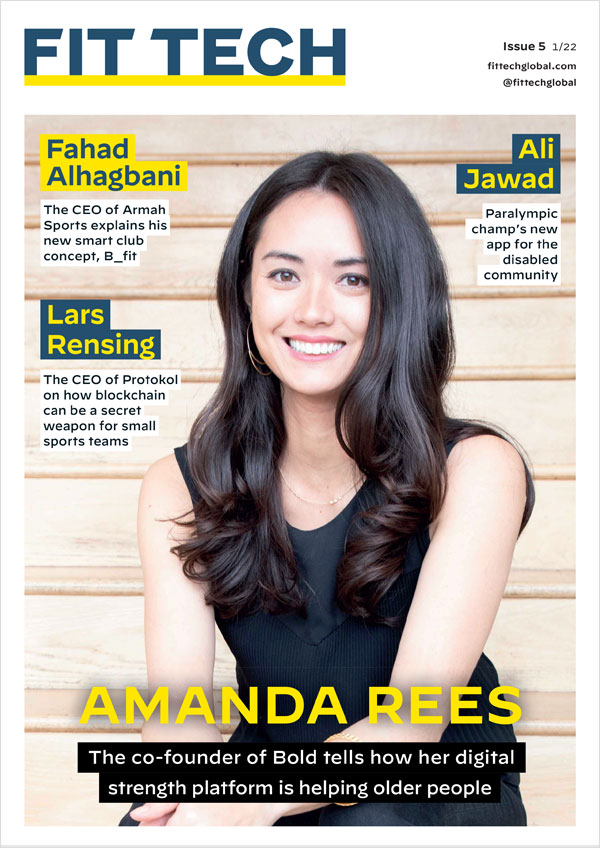
Bold move

We ended up raising US$7m in venture capital from incredible investors, including Andreessen Horowitz, Khosla Ventures, Primetime Partners, and GingerBread Capital
App analysis

Check your form

Sency’s motion analysis technology is allowing users to check their technique as they exercise. Co-founder and CEO Gal Rotman explains how
Profile

New reality

Sam Cole, CEO of FitXR, talks to Fit Tech about taking digital workouts to the next level, with an immersive, virtual reality fitness club
Profile

Sohail Rashid

35 million people a week participate in strength training. We want Brawn to help this audience achieve their goals
Ageing

Reverse Ageing

Many apps help people track their health, but Humanity founders Peter Ward and Michael Geer have put the focus on ageing, to help users to see the direct repercussions of their habits. They talk to Steph Eaves
App analysis

Going hybrid

Workout Anytime created its app in partnership with Virtuagym. Workout Anytime’s Greg Maurer and Virtuagym’s Hugo Braam explain the process behind its creation
Research

Physical activity monitors boost activity levels

Researchers at the University of Copenhagen have conducted a meta analysis of all relevant research and found that the body of evidence shows an impact
Editor's letter

Two-way coaching

Content providers have been hugely active in the fit tech market since the start of the pandemic. We expect the industry to move on from delivering these services on a ‘broadcast-only’ basis as two-way coaching becomes the new USP
Fit Tech People

Laurent Petit

Co-founder, Active Giving
The future of sports and fitness are dependent on the climate. Our goal is to positively influence the future of our planet by instilling a global vision of wellbeing and a sense of collective action
Fit Tech People

Adam Zeitsiff

CEO, Intelivideo
We don’t just create the technology and bail – we support our clients’ ongoing hybridisation efforts
Fit Tech People

Anantharaman Pattabiraman

CEO and co-founder, Auro
When you’re undertaking fitness activities, unless you’re on a stationary bike, in most cases it’s not safe or necessary to be tied to a screen, especially a small screen
Fit Tech People

Mike Hansen

Managing partner, Endorphinz
We noticed a big gap in the market – customers needed better insights but also recommendations on what to do, whether that be customer acquisition, content creation, marketing and more
More features
Matrix provides equipment to facilities in all market sectors including private health clubs, residential housing, ...
EGYM partners with companies to improve employee health by providing access to fitness and health ...
22-23 Sep 2026
Four Seasons Hotel Bangkok at Chao Phraya River, Bangkok , Thailand
Matrix provides equipment to facilities in all market sectors including private health clubs, residential housing, ...
EGYM partners with companies to improve employee health by providing access to fitness and health ...
Get Fit Tech
Sign up for the free Fit Tech ezine and breaking news alerts
Sign up
22-23 Sep 2026
Four Seasons Hotel Bangkok at Chao Phraya River, Bangkok , Thailand

latest fit tech news

Preventive healthcare company Neko Health has added body composition analysis to its full-body health scan and launched a new mobile ...
news • 24 Jun 2026

A new brain clinic has opened in London, which uses non-invasive brain stimulation to treat chronic pain, anxiety and burnout ...
news • 22 Jun 2026

Samsung has unveiled a suite of AI-powered health features for its Galaxy Watch range, as the technology giant ...

news • 22 Jun 2026

Elevate Arena is underway at London's Excel and the hot topic of AI was the first point of discussion on ...
news • 18 Jun 2026
Peloton has made the strategic acquisition of Pilates start-up, Skōp, to support the expansion of its strength ecosystem. As demand ...
news • 09 Jun 2026

Longevitix, a clinical platform for preventive and longevity medicine, has launched its AI-powered intelligence system to help physicians deliver continuous, ...
news • 08 Jun 2026

Fitness First UK is integrating red light therapy into its yoga and Pilates classes through a partnership with Bon Charge. ...
news • 08 Jun 2026
PureGym is encouraging people to step away from their screens and go for a walk, in a new initiative timed ...
news • 29 May 2026
Active people app, Strava, has overhauled its strength training experience, allowing gym-goers to automatically log and share their lifts from ...
news • 27 May 2026

Fitness First UK is embracing digital wellness technology by installing Kip’s tap-to-activate phone controls across its UK estate. Kip tags ...
news • 22 May 2026
More fit tech news
features

Feedback: HCM Forum

Fuel the debate about issues and opportunities across the industry. We’d love to hear from you. Write to [email protected]

Published in Health Club Management 2026 issue 2

Alex Lucas, Research manager, UK Active
Alex Lucas, Research manager, UK Active / Alex Lucas
UK Active’s work with insight firm Beano Brain casts light on Gen Alpha
Alex Lucas, Research manager, UK Active

We welcome the recent feature in HCM on Gen Alpha which showed a strong focus by operators across our sector in engaging the next generation (HCM issue 1 2026, p72).

Gen Alpha represents about 11.75 million people or 17 per cent of the UK population, making it an important audience for our sector as current and future users of our facilities.

Over the past six years there’s been a 12 per cent rise in the number of children and young people getting active and understanding this generation’s motivations is vital to ensure our sector is ready to welcome them.

UK Active conducted polling with family insight agency Beano Brain, which found 40 per cent of children aged seven to 14 want to be more physically active and almost half (49 per cent) said they’d like to be fit and healthy as adults.

Our findings also revealed what helps Gen Alpha enjoy being active, with top factors being ‘taking part in activities with friends’ (63 per cent), ‘having a friendly and supportive coach’ (46 per cent) and ‘being in a familiar place’ (42 per cent). This shows the importance that a social, supportive and familiar environment plays in supporting children’s activity.

Gen Alpha represents about 11.75 million people or 17 per cent of the UK  population, making it an important audience for our sector

Insight from UK Active’s recent qualitative evaluation of the Opening School Facilities programme mirrors these findings. Through this programme, schools and leisure facilities built relationships to enable access to activities outside school.

Through focused interviews, we found children built the confidence to use leisure facilities and gyms by being able to access them earlier in life. They were also more likely to enjoy being active in these settings if they were supported with a social community, relaxed environment and friendly, supportive coaches.

40 per cent of children aged seven to 14 want to be more physically active

Next steps for operators

This data provides insight into how operators can improve, adapt or refine their programmes to support participation. Simple steps can be taken to welcome these age groups into our facilities and we encourage operators to use UK Active’s new guidance, Children and young people in gym and group exercise facilities to guide decision-making.

Early, positive experiences with physical activity are vital to children’s healthy development and to building lifelong habits. The physical literacy consensus for England – a statement which provides a shared understanding of why physical activity matters and how it can be developed and supported – highlights that the way children feel when they’re active, who they’re active with and the spaces they’re active in influence their experience and relationship with exercise.

It’s more important than ever that the next generation builds a lasting relationship with physical activity and our sector is ready to play its part in creating lifelong exercise habits.

David Joerring, founder and CEO, HealthKey
David Joerring, founder and CEO, HealthKey / David Joerring
Venturing into the clinical: what GLP-1s mean for operators
David Joerring, founder and CEO, HealthKey

I read your editor’s letter on sector trends with interest, particularly the growing visibility of GLP-1s in the fitness environment – from PT education to operators directly offering access to medication.

It’s clear that GLP-1s can support positive outcomes when used appropriately, alongside training, nutrition and behaviour change.

Working with operators who are introducing GLP-1 programmes, I’m struck by the clear shift it represents into genuinely clinical territory. This creates opportunity, but also a level of responsibility many operators haven’t historically had to carry.

Once a health club engages with clinical interventions, such as weight-management medication and diagnostics, it’s no longer just about member engagement or growth. It’s about clinical governance, provider-vetting, safeguarding and the quality and continuity of care. Getting this wrong carries reputational and operational risk.

The challenge for operators isn’t so much whether to engage, it’s more about how to do so responsibly, while upholding trust and driving long-term results.

Clinical engagement is not a shortcut to growth. It’s a discipline in its own right

This is achieved by introducing the correct wraparound care and building experiences that are coherent, safe and aligned with their brand.

This is where we see a growing need for infrastructure, not just innovation. As operators move closer to healthcare, they need partners who can help them design clinical programmes, carry out proper due diligence on providers, ensure compliance and reduce the complexity that comes with operating across fitness and healthcare simultaneously.

At HealthKey, our role is to sit in that gap, helping operators build clinically-led health programmes without having to become healthcare organisations themselves.

That includes supporting clinical governance and programme design, while enabling members to access care through experiences that feel integrated with their fitness journey, rather than bolted on.

GLP-1s – and the broader expansion into preventative and clinical services – represent a significant opportunity for the sector, but only if operators approach it with the same rigour they apply to training standards and member safety. Clinical engagement is not a shortcut to growth. It’s a discipline in its own right. 

Sign up here to get Fit Tech's weekly ezine and every issue of Fit Tech magazine free on digital.
More features
Editor's letter

Into the fitaverse

Fitness is already among the top three markets in the metaverse, with new technology and partnerships driving real growth and consumer engagement that looks likely to spill over into health clubs, gyms and studios
Fit Tech people

Ali Jawad

Paralympic powerlifter and founder, Accessercise
Users can easily identify which facilities in the UK are accessible to the disabled community
Fit Tech people

Hannes Sjöblad

MD, DSruptive
We want to give our users an implantable tool that allows them to collect their health data at any time and in any setting
Fit Tech people

Jamie Buck

Co-founder, Active in Time
We created a solution called AiT Voice, which turns digital data into a spoken audio timetable that connects to phone systems
Profile

Fahad Alhagbani: reinventing fitness

The team is young and ambitious, and the awareness of technology is very high. We share trends and out-of-the-box ideas almost every day
Opinion

Building on the blockchain

For small sports teams looking to compete with giants, blockchain can be a secret weapon explains Lars Rensing, CEO of Protokol
Innovation

Bold move

We ended up raising US$7m in venture capital from incredible investors, including Andreessen Horowitz, Khosla Ventures, Primetime Partners, and GingerBread Capital
App analysis

Check your form

Sency’s motion analysis technology is allowing users to check their technique as they exercise. Co-founder and CEO Gal Rotman explains how
Profile

New reality

Sam Cole, CEO of FitXR, talks to Fit Tech about taking digital workouts to the next level, with an immersive, virtual reality fitness club
Profile

Sohail Rashid

35 million people a week participate in strength training. We want Brawn to help this audience achieve their goals
Ageing

Reverse Ageing

Many apps help people track their health, but Humanity founders Peter Ward and Michael Geer have put the focus on ageing, to help users to see the direct repercussions of their habits. They talk to Steph Eaves
App analysis

Going hybrid

Workout Anytime created its app in partnership with Virtuagym. Workout Anytime’s Greg Maurer and Virtuagym’s Hugo Braam explain the process behind its creation
Research

Physical activity monitors boost activity levels

Researchers at the University of Copenhagen have conducted a meta analysis of all relevant research and found that the body of evidence shows an impact
Editor's letter

Two-way coaching

Content providers have been hugely active in the fit tech market since the start of the pandemic. We expect the industry to move on from delivering these services on a ‘broadcast-only’ basis as two-way coaching becomes the new USP
Fit Tech People

Laurent Petit

Co-founder, Active Giving
The future of sports and fitness are dependent on the climate. Our goal is to positively influence the future of our planet by instilling a global vision of wellbeing and a sense of collective action
Fit Tech People

Adam Zeitsiff

CEO, Intelivideo
We don’t just create the technology and bail – we support our clients’ ongoing hybridisation efforts
Fit Tech People

Anantharaman Pattabiraman

CEO and co-founder, Auro
When you’re undertaking fitness activities, unless you’re on a stationary bike, in most cases it’s not safe or necessary to be tied to a screen, especially a small screen
Fit Tech People

Mike Hansen

Managing partner, Endorphinz
We noticed a big gap in the market – customers needed better insights but also recommendations on what to do, whether that be customer acquisition, content creation, marketing and more
More features